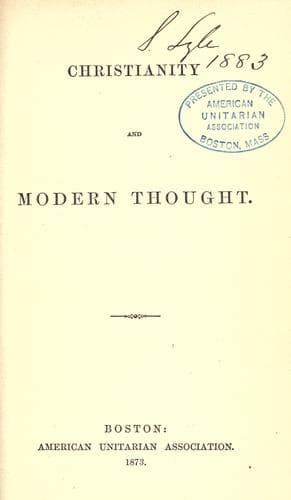
Christianity and Modern ThoughtPeabody, Andrew P. (Andrew Preston)
Religion
Christianity and Modern Thought
Peabody, Andrew P. (Andrew Preston)
Unitarianism
The writer to the Hebrews affirms that Jesus Christ is "the same
yesterday, to-day, and for ever." Paul exclaims to the Corinthians,
"Though we have known Christ after the flesh, yet now henceforth know we
him no more." Christ was the same; yet before the generation that he
left upon the earth had passed away his relation to the earth had
changed. Thus does the work of Christ shape itself afresh to meet the
needs of every generation. Compare together the Christ of the first
century, the Christ of the thirteenth, the Christ of the sixteenth, and
the Christ of the nineteenth centuries, and you would hardly think they
all represent the same personality. Christ is always the same. His work
is always substantially the same; but because the ages change, the
method of this work changes. The same needs always exist in the heart of
humanity, but in different ages these needs manifest themselves in
different ways, and are to be met by different instrumentalities. And,
further, it is not merely because the needs of humanity continually
change their aspect that the work of Christ is ever changing. No age is
a recipient alone. There is no action without reaction Each age
contributes something to the work of Christ. It adds new forces, new
methods, new machinery. Its spirit, and by this I mean its real, vital,
energizing spirit, becomes united with the spirit of Christ, as it is
present and active in the world.
In considering the relation of Christ to the present age, we have then
to consider it under two aspects. We have to consider each as a giver,
and each as a receiver. We may help to make this double relation clear
by saying that Christ is present to this nineteenth century at once as a
problem and as a power. No questions have stirred more deeply the heart
of the age than those which have to do with the person and the office of
Christ. The answers to these questions shape the aspect in which he
stands to the age, and become therefore parts and elements of the power
by which he acts upon the world. But this statement does not exhaust the
twofold relation of which I speak. That which the age gives to Christ is
not merely its thought about him. The secular thought and life of the
age bring their contribution, they are themselves a contribution to him.
They furnish one part of that complete organism of which Christ
furnishes the other. If the age, in any fundamental forms of its thought
and life, seems to stand in opposition to Christ, this apparent
opposition is only the antithesis of elements which belong together. If
what we call the spirit of the age seems, in any respect, to stand in
opposition to the spirit of Christ, this only shows the need that each
has of the other. The spirit of this nineteenth century needs the spirit
of Christ, and the spirit of Christ needs the spirit of this nineteenth
century. It is not then merely that the thought of the age clears away
something of the obscurity and the misconception that have gathered
Public-domain text, read in full here on John Shaqi.
Reviews
Reviews
No reviews yet
Be the first to share your thoughts on this work.
Elsewhere in the archive
Join the Discussion
Join the discussion
Sign in to leave a comment or review.
Sign InorCreate an account