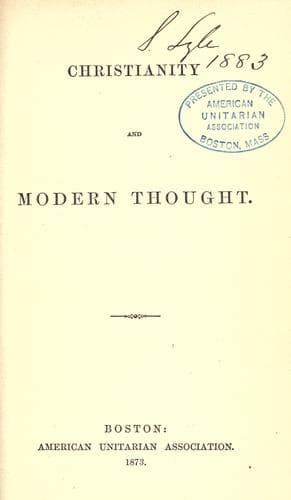
Christianity and Modern ThoughtPeabody, Andrew P. (Andrew Preston)
Religion
Christianity and Modern Thought
Peabody, Andrew P. (Andrew Preston)
Unitarianism
about the person and the work of Christ. If all he said and did were as
truly comprehended now as they could have been at the first, no less
real, no less important, would be the offering which this age would
bring to him. Neither does the fact, that the work of Christ needs the
work, and that his spirit needs the spirit, of the century in which we
live, necessarily imply any imperfection in his original work, or any
thing originally lacking in his spirit. The question as to what he had
in reserve, as to the limit, or the lack of limit, of his insight and
comprehension, is one that I do not need, and do not intend here to
raise. There is a kind of work that cannot be done all at once. There is
a fulness of spirit that cannot manifest itself all at once. It is
sufficient to know that Christ recognized this fact as well as we can.
He affirmed it as clearly and as confidently as it is possible for us to
do. "I have," he said to his disciples, "yet many things to say unto
you, but ye cannot bear them now. Howbeit, when he, the Spirit of truth,
is come, he shall lead you into all truth." All, so far as we can see,
that it was possible for any spirit to do at one moment, Christ did. He
infused into the world a spirit of love and faith and consecration, a
principle of enthusiasm for humanity. He added to these the vitalizing
power that came from his personality. This he did, and with this he was
forced to be content. He told us the nature of his work, and foretold to
us its history. It was to be as a little leaven which a woman hideth in
a measure of meal till the whole is leavened. He hid in the world the
leaven of his truth. That was all that he could do. It is for us to
witness, and to contribute to, the completion of his work.
In considering the theme before us, I shall speak, first, of the
external history of Christ, next of his teaching, and finally of his
personality, in their relation to the present age.
In considering the relation of Christ to the present age, we are met,
then, first by the most external form of this relation. The external
history of Christ, the very framework of many of his highest and purest
teachings, contains elements that are utterly opposed to the habits of
thought which are most peculiar to the present century. I refer to
whatever in the history of Christ implies the exercise of any miraculous
power by him.
Public-domain text, read in full here on John Shaqi.
Reviews
Reviews
No reviews yet
Be the first to share your thoughts on this work.
Elsewhere in the archive
Join the Discussion
Join the discussion
Sign in to leave a comment or review.
Sign InorCreate an account