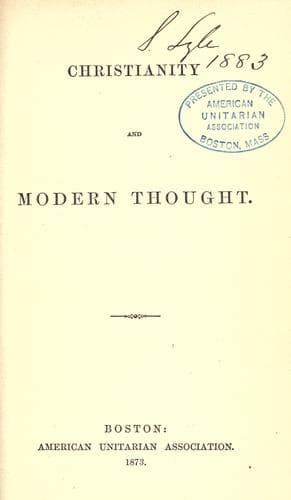
Christianity and Modern ThoughtPeabody, Andrew P. (Andrew Preston)
Religion
Christianity and Modern Thought
Peabody, Andrew P. (Andrew Preston)
Unitarianism
The idea of a miracle is opposed to the fundamental axioms of the
popular thought of the present. The writers who best represent this
thought do not hold it necessary to disprove the fact of miracles. They
simply affirm, with Strauss, that the time is past when a miracle can be
believed. On the other hand, the miraculous is inextricably intertwined
with the history of Christ. We find miracles recognized, not merely in
records the genuineness of which has, with or without reason, been
suspected. In Epistles of Paul, the genuineness of which no critic of
repute has ever dreamed of assailing, the miraculous element is
recognized as distinctly as in the Gospels. We have at least the
testimony of Paul--one of the grandest souls that ever lived, a man whom
we know and honor as we know and honor few--that he believed himself to
have wrought miracles, and that he believed the other apostles had done
and were in the habit of doing the same. And we further have his
testimony, with that of others indorsed by him, in regard to the most
important of the miracles of Jesus; namely, the manifestation by Jesus
of himself to his disciples after his death.
Here is a collision between the form of the external manifestation of
Christ and the spirit of the age. The age itself has given such
prominence to this that we cannot overlook it. The idea of miracle is so
foreign to the spirit of the age that it has a fascination for it. It
has less importance than any thing else in the history of Jesus, and yet
nothing has more occupied the thoughts of the thinkers of the present
generation.
For the reasons already stated, we must concede a certain degree of
right to both sides of the great controversy. If we cannot eliminate the
miraculous from the history of Jesus, neither can we, nor would we if we
could, eliminate from the spirit of the age that element which finds it
hard to accept a miracle. The very antagonism between the two, the right
which each maintains being granted, shows the need that each has of the
other. Each has a contribution for the other which could be received
from no other source.
Public-domain text, read in full here on John Shaqi.
Reviews
Reviews
No reviews yet
Be the first to share your thoughts on this work.
Elsewhere in the archive
Join the Discussion
Join the discussion
Sign in to leave a comment or review.
Sign InorCreate an account