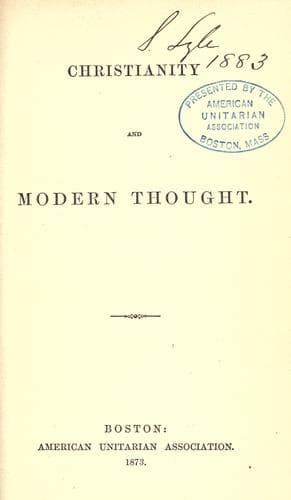
Christianity and Modern ThoughtPeabody, Andrew P. (Andrew Preston)
Religion
Christianity and Modern Thought
Peabody, Andrew P. (Andrew Preston)
Unitarianism
On the other hand, miracle brings a no less important contribution to
the spirit of the age. This spirit tends, not only to look upon law as
absolute, but to look upon the system of laws which it has discovered as
final. These laws tend continually to become narrow and hard. They tend
to become merely a system of physical forces. There is danger that the
spirit may become shut up within these physical laws as in a
prison-house. The miracle demonstrates to the senses that these physical
laws are not absolute, even in their own realm; that these physical
forces are encompassed and interpenetrated by spiritual forces; that
matter is at the last subordinate to spirit. It may not reveal the
nature of these spiritual forces; but it does reveal their presence. All
do not need this demonstration. The same truth may be reached in other
ways. The laws of thought reveal it. The spiritual consciousness may be
sufficient unto itself. Christ himself regarded his miracles as of
comparatively small account. He wrought them because he was moved to use
whatever power he had to bless mankind. If he healed the sick, it was
because he loved to heal them. He sympathized with sorrow and suffering,
and, so far as he could, would remove their cause. But the miracles
carry, as we have seen, their own revelation with them; and they have
their place, however lowly, in regard even to the spiritual
consciousness. The albatross, we are told, with all its magnificent
sweep of wing, cannot lift itself from the flat surface of the deck on
which it may be lying. Just because its wings are so strong and large,
it needs to be lifted a little, that they may have space to move, that
they may have freedom to smite the air. When this freedom has been given
it, then it mounts upward, sustained by its own inherent strength. So is
it, sometimes, with the spirit. It has strength of its own. It has a
self-sustaining power. But it sometimes needs to be lifted a little way
above the dead level of its daily life, above the plane of physical
relations, before its wings find strength and freedom to beat the air.
Then, leaving its temporary support behind it, it mounts in glad flight
heavenward. Such help many have found, and may yet find, in the miracles
of Jesus. The miracle may lift the level surface of life as if into a
wave, from the crest of which the spirit may start upon its flight.
From the external manifestation of the history of Christ, and the
external relations in which through this he stands to the present age,
we pass to the inner power of this life. Within these external
manifestations we find his teachings. We have, then, next to consider
the relation in which Christ stands to the present age as a teacher. We
shall find here the same twofold relation which we have found before;
and the external may thus stand as a type and illustration of the
internal. We will first consider, under this aspect, the basis and form
of the teaching of Christ, and next its substance.
Public-domain text, read in full here on John Shaqi.
Reviews
Reviews
No reviews yet
Be the first to share your thoughts on this work.
Elsewhere in the archive
Join the Discussion
Join the discussion
Sign in to leave a comment or review.
Sign InorCreate an account