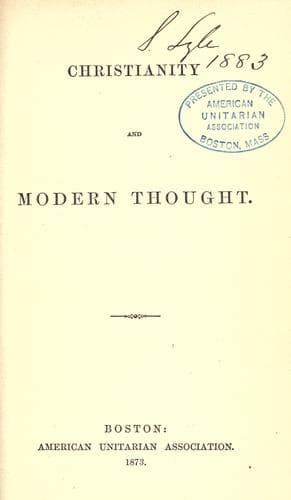
Christianity and Modern ThoughtPeabody, Andrew P. (Andrew Preston)
Religion
Christianity and Modern Thought
Peabody, Andrew P. (Andrew Preston)
Unitarianism
The spirit of the age is truth-seeking. We speak often of the eagerness
for wealth that marks the age. I think that when, from the distant
future, men shall look back upon this period of the world's history, the
search for wealth will not be seen to fill the place that to us it seems
to occupy. The age will be seen to be animated by a nobler quest than
this. The search for truth will be seen to be the quest by which it is
marked most really. We speak of the corruption of the age, of the
trickeries of trade, of the unscrupulousness of speculation, of the
pretence and display of fashion, of the venality of politics. All this
is true. These things deserve the denunciation of the moralist and the
preacher. But behind all this is the life which truly marks the age. It
is the life of patient, earnest, honest search for truth. I believe that
never and nowhere has there been manifested, to so great extent, such
conscientious and self-forgetful love of truth for its own sake as may
be found in the scientific investigations of the present day. Such
accuracy of research, such microscopic delicacy of measurement, such
patient and unprejudiced examination, I believe to be unequalled in the
history of man. This proves that, in spite of the frauds and falseness
of which I spoke, the age is really sound at heart. Theologians
sometimes speak of the flippancy and conceit of the science of the day.
The terms would be more true applied in the opposite direction. Theology
is more open to such charges than science. A love of truth that would
fling away even the highest glory of the earth and the hope of heaven,
if so be truth may stand pure and perfect, has something sublime about
it. Well might the theologian take a lesson from the man of science in
regard to this consecration to truth. For theology, with its
presumption, its prejudice, its pretence, its glossing over of
difficulties, its leaning upon authority which it feels at heart is not
authority, its saying what it does not exactly believe, that it may not
contradict those who perhaps do not believe exactly what they say, may
well stand ashamed in the presence of the science of the day that has
left all to follow truth. Theology should give to science not
tolerance, not patronage, but reverence. While it utters fearlessly the
truth that is given it to speak, it should in its turn seat itself as a
learner at the feet of science, and seek not only to gather the facts
which it has to teach, but to catch something of its spirit, the spirit
that loves truth, and that will suffer nothing to take the place of
this.
Public-domain text, read in full here on John Shaqi.
Reviews
Reviews
No reviews yet
Be the first to share your thoughts on this work.
Elsewhere in the archive
Join the Discussion
Join the discussion
Sign in to leave a comment or review.
Sign InorCreate an account