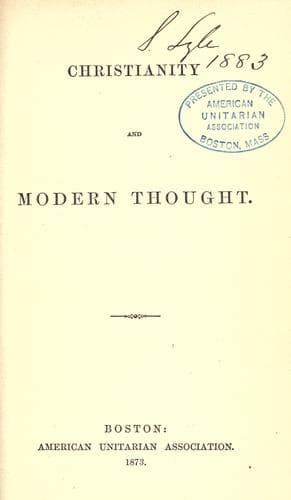
Christianity and Modern ThoughtPeabody, Andrew P. (Andrew Preston)
Religion
Christianity and Modern Thought
Peabody, Andrew P. (Andrew Preston)
Unitarianism
This tendency of the thought of the age is not based on error. It brings
to our thought of personality the correction that it needs. The tendency
of the past has been to look upon personality as existing by and for
itself. It has recognized no limits to the power of freedom. Each
individual stood by and for himself in the universe. Now we see a common
element in all lives. All lives are entwined together. We see limits
which freedom cannot pass. We understand something of the limits of each
individual. We understand something of the laws of descent and of the
power of education. Even the personality of Jesus does not stand by
itself as it seemed to once. We see in him the power of the common
nature. We see in him the effect of forces which had been in operation
since the world was. He was no stranger upon the earth. He was the Son
of God, but he was no less the Son of man. He was the flowering of a
nation's history, the flowering of humanity. The flower is drawn forth
by the sun, but it is drawn out from the plant. Even the sun can kindle
the flame of no rose upon the bramble's stalk. While, however, the age
teaches us what is the background out from which the power of
personality stands forth, and what are the elements that are fused
together in it, personality itself remains too much unrecognized. But, I
repeat, the integrity of human nature can never be violated; and
personality is the culmination of human nature. The power of a modern
army, we have seen, depends largely on its drill; yet even here the
impetuous courage of a leader may infuse a life into this vast machine
that shall decide the victory. Mere signals, it is found, upon a ship
will not answer the purpose of communication between the captain and the
men. In times of peril, in the midst of the fury of the storm, the
sailor needs the inspiration of the captain's voice, ringing with a
force that is mightier than the tempest; namely, the force of human will
and courage. No matter how mechanical the age may become, no matter how
the idea of freedom may be eliminated from its thought, the great heart
of humanity beats still in its bosom, and the voice of a strong, free
personality will sooner or later arouse it to an answering
consciousness. The very bands which it sets about personality will make
its power more strongly felt when it is perceived. Its very knowledge of
the elements that are united in it will make it feel more really the
might of the force which can fuse these into one burning point.
Public-domain text, read in full here on John Shaqi.
Reviews
Reviews
No reviews yet
Be the first to share your thoughts on this work.
Elsewhere in the archive
Join the Discussion
Join the discussion
Sign in to leave a comment or review.
Sign InorCreate an account