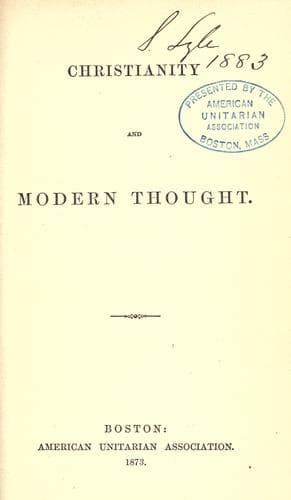
Christianity and Modern ThoughtPeabody, Andrew P. (Andrew Preston)
Religion
Christianity and Modern Thought
Peabody, Andrew P. (Andrew Preston)
Unitarianism
Personality involves three elements. The first is freedom; the second, a
purpose freely chosen; the third, devotion to this purpose. There is no
slavery like sin. Absolute freedom, and thus absolute personality, can
be found only in a nature wholly pure and unselfish. Christ was thus
free. His purpose was the vastest that any human soul has grasped; and
he gave himself to it with all the power of his nature. Thus Christ
possessed the most intense personality ever felt upon the earth. His
teaching came forth glowing with its fire. We feel to-day the effect
which his personality produced upon those who came into direct contact
with it. This influence has propagated itself from age to age. The
Church grew out of it, and its influence is felt to-day far beyond the
limits of the Church. Besides this indirect power of the personality of
Jesus, we may feel its force directly, as we bring ourselves into
personal relation with him. It has not lost its original might. It still
tends to reproduce itself in the present.
The form in which truth first utters itself has a power which no
subsequent repetition can equal. There is a kind of work that can be
done only once. The first discoverer or announcer of any truth stands in
a relation to it which no other can ever fill. Many navigators have
crossed the sea, but there is only one Columbus. Many astronomers have
searched the heavens, but there has been no second Newton. This fact is
most noticeable in regard to truths that represent not merely the
intellect, but the whole moral and spiritual nature of him who first
uttered them in their fulness. There is a fact in science strange,
apparently illogical, but yet unquestionable. It is this: The power of
heat-bearing rays to pass through any resisting medium depends not upon
the temperature of the rays, but upon that of the body from which they
come. The heat-bearing rays of the sun that approach the earth hardly
differ in temperature from the rays that are reflected from it; but the
former pass almost unimpeded through the atmosphere by which the latter
are to a great extent imprisoned. The rays reach the earth without
difficulty, but are entrapped by the principle referred to, and remain
to bless the world. The first have this power to pass through the
atmosphere because they come direct from the burning body of the sun.
The reflected rays have lost this power, because they proceed from the
colder earth. This law is as true in the intellectual and spiritual as
it is in the physical world. The power of moral and spiritual truths to
penetrate to the hearts of men has this strange dependence upon the
moral and spiritual power of him who utters them. The very spontaneity
of this utterance is a revelation of this power. It is because the truth
that Jesus uttered came forth from his glowing heart of love, it is
because it sprang fresh and spontaneous from the intensity of his
spiritual life, that it has such power to-day to touch the hearts of
men.
Public-domain text, read in full here on John Shaqi.
Reviews
Reviews
No reviews yet
Be the first to share your thoughts on this work.
Elsewhere in the archive
Join the Discussion
Join the discussion
Sign in to leave a comment or review.
Sign InorCreate an account