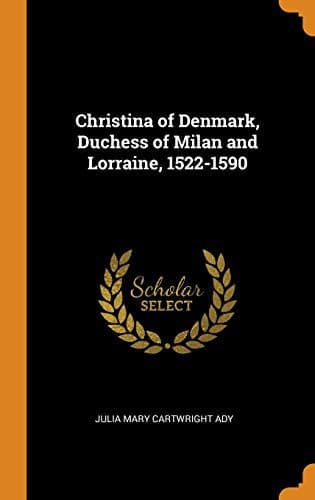
Christina of Denmark, Duchess of Milan and Lorraine, 1522-1590Cartwright, Julia
History
Christina of Denmark, Duchess of Milan and Lorraine, 1522-1590
Cartwright, Julia
Christine, Duchess, consort of Francis I, Duke of Lorraine, 1521-1590; Europe -- History -- 1517-1648
The Emperor, however, was still friendly. His heart was set on a
Crusade against the Turk, and he had no wish to embark on war with
England. Pole met with a cold reception at Toledo, and, finding
Charles averse to executing the Pope's sentence, retired to his friend
Sadoleto's house at Carpentras. This was a relief to Henry, and he bade
Wyatt thank his imperial brother, but could not forbear pointing out
that these friendly words agreed ill with the doings of his officers
in the Low Countries. A despatch addressed to Wyatt on the 10th of
March contains a long recital of the extraordinary treatment which his
Ambassadors at Brussels had met with:
"Since Lent began, as for a penance, their entertainment
hath been marvellous strange--yea, and stranger than we will
rehearse: strangeness in having audience with long delay,
strangeness in answer and fashion. Also they have been
constrained to pay Excise, which no Ambassador of England paid
in any man's remembrance. They have complained to the Queen,
but nevertheless must pay or lack drink.... These rumours
and hints of war, the arrest of our ships, this strangeness
shown to our Ministers, this navy and army in readiness, the
recall of Chapuys, ran abroad this realm and everywhere. We
do not write to you the rumours half so spiteful, and the
entertainment half so strange, as it hath been. I think never
such a thing was heard, and especially after a treaty of
marriage such a banquet!"[240]
Henry concluded this letter by saying that, since the Emperor insisted
on the need of Papal dispensation, there could be no further question
of any marriage between him and the Duchess, and he would be now at
liberty to seek another wife. On the same day he wrote to Carne, who
had been secretly corresponding with the Duke of Cleves, telling him to
open negotiations for a marriage with that Prince's sister, the Lady
Anne.[241]
Twelve days after this despatch was sent to Spain Wriothesley left
Brussels. At Calais he met Chapuys, who had just crossed the Channel,
and Mary's almoner, the Dean of Cambray, who was being sent to take the
Ambassador's place, and was awaiting a fair wind to embark for Dover.
All three Ambassadors dined in a friendly manner with Lord Lisle, the
Deputy Governor of Calais, and continued their respective journeys
without hindrance. But the much-discussed marriage treaty was at an
end. The long-drawn comedy had reached its last act. "All hope of the
Duchess," wrote Wriothesley to Cromwell, "is utterly past."
[Sidenote: AUG., 1539] A WELSHMAN'S OPINION]
The rupture was loudly lamented by the English merchants in Antwerp,
and keen disappointment was felt throughout England, where the marriage
had always been popular. Among many scattered notices of the feeling
which prevailed on the subject, the following incident is of especial
interest, because of the sidelight which it throws on Christina's
personal reluctance to the marriage.
Public-domain text, read in full here on John Shaqi.
Reviews
Reviews
No reviews yet
Be the first to share your thoughts on this work.
Elsewhere in the archive
Join the Discussion
Join the discussion
Sign in to leave a comment or review.
Sign InorCreate an account