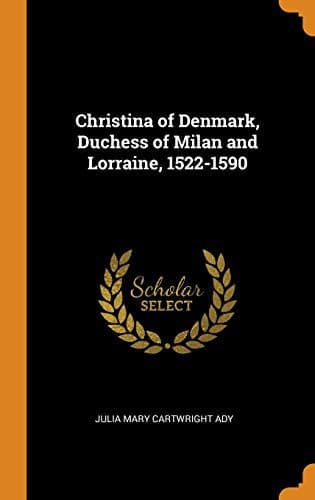
Christina of Denmark, Duchess of Milan and Lorraine, 1522-1590Cartwright, Julia
History
Christina of Denmark, Duchess of Milan and Lorraine, 1522-1590
Cartwright, Julia
Christine, Duchess, consort of Francis I, Duke of Lorraine, 1521-1590; Europe -- History -- 1517-1648
On a summer evening in August, 1539, five months after Wriothesley
left Brussels, a married priest named George Constantyne, of Llan
Hawaden in South Wales, rode from Chepstow to Abergavenny with John
Barlow, Dean of Westbury. The priest had got into trouble in Wolsey's
time, for buying copies of Tyndale's New Testament, and was forced to
fly the country and practise as a physician for several years in the
Netherlands. Now he had returned to England, and was on his way to his
old home in Wales. He walked from Bristol to Westbury, where he supped
with Dean Barlow, a brother of his friend the Bishop of St. Davids,
who made him heartily welcome, and invited him to be his travelling
companion the next day to Pembrokeshire. As the two ecclesiastics rode
through the green valleys on the way to Abergavenny, the Dean asked
Constantyne if he could tell him why the King's marriage had been so
long delayed. The priest replied that he, for his part, was very sorry
the King should still be without a wife, when he might by this time
have been the father of fair children. As the Dean knew, both the
Duchess of Milan and she of Cleves were spoken of, and now the little
doctor, Nicholas Wotton, had been sent to Cleves with Mr. Beard, of
the Privy Chamber, and the King's painter; so there was good hope
of a marriage being concluded with the Duke of Cleves, who favoured
God's word, and was a mighty Prince now, holding Guelderland against
the Emperor's will. But why, asked the Dean, was the marriage with
the Duchess of Milan broken off? Constantyne, who was familiar with
all the gossip of the Regent's Court, replied that the Duchess quite
refused to marry the King, unless he would accept the Bishop of Rome's
dispensation, and give pledges that her life would be safe and her
honour respected. "Why pledges?" asked the Dean innocently. "Marry!"
returned Constantyne, "she sayeth that, since the King's Majesty was in
so little space rid of three Queens, she dare not trust his Council,
even if she dare trust His Majesty. For in Flanders the nobles suspect
that her great-aunt, Queen Catherine, was poisoned, that Anne Boleyn
was innocent of the crimes for which she was put to death, and that the
third wife, Queen Jane, was lost for lack of attention in childbed."
Such, at least, were the mutterings which he heard at Court before
Whitsuntide. The Dean remarked that he was afraid the affair of Milan
must be dashed, as Dr. Petre, who was to have gone to fetch the royal
bride from Calais, was at the Court of St. James's last Sunday; upon
which Constantyne gave it as his opinion that there could be no amity
between the King and the Emperor, whose god was the Pope.
Public-domain text, read in full here on John Shaqi.
Reviews
Reviews
No reviews yet
Be the first to share your thoughts on this work.
Elsewhere in the archive
Join the Discussion
Join the discussion
Sign in to leave a comment or review.
Sign InorCreate an account