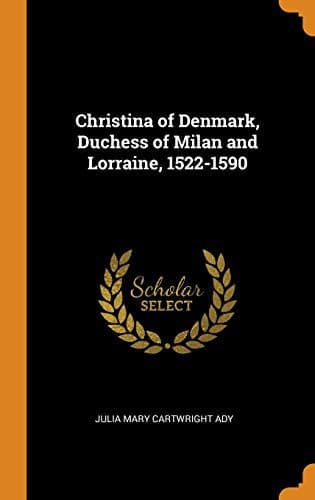
Christina of Denmark, Duchess of Milan and Lorraine, 1522-1590Cartwright, Julia
History
Christina of Denmark, Duchess of Milan and Lorraine, 1522-1590
Cartwright, Julia
Christine, Duchess, consort of Francis I, Duke of Lorraine, 1521-1590; Europe -- History -- 1517-1648
[226] Calendar of State Papers, xiv. 1, 37.
[227] State Papers, Record Office, viii. 139.
[228] State Papers, Record Office, viii. 140-148.
[229] Calendar of State Papers, xiv. 1, 93, 121.
[230] _Ibid._, xiv. 1, 14; Calendar of Spanish State Papers, vi. 1, 97.
[231] _Ibid._, xiv. 1, 26.
[232] Calendar of State Papers, xiv. 1, 16-19.
[233] _Ibid._, xiv. 1, 52; Lanz, ii. 297-306.
[234] Nott, ii. 306.
[235] Calendar of Spanish State Papers, vi. 1, 145.
[236] Kaulek, 84.
[237] Calendar of State Papers, xiv. 1, 125, 126
[238] State Papers, Record Office, viii. 155.
[239] State Papers, Record Office, viii. 166, 175.
[240] Nott, "Life of Wyatt," II. 511.
[241] Calendar of State Papers, xiv. 1, 189, 191.
[242] "Archæologia Cambrensis," xxiii. 139-141.
BOOK VII
CLEVES, ORANGE, AND LORRAINE
1539-1541
I.
The negotiations for the King of England's marriage with the Duchess of
Milan were broken off. But there was no lack of suitors for Christina's
hand. During the winter and spring of 1539 the Emperor's niece received
offers of marriage from three princely bridegrooms. The first of these
was Antoine, Duke of Vendôme, whose courtship of the Duchess on the
journey to Compiègne had aroused King Henry's jealousy. The second was
William of Cleves, who since the old Duke Charles's death had taken
possession of Guelders, and was now seeking to obtain the investiture
of the duchy, together with Christina's hand. The third was Francis,
the Marquis of Pont-à-Mousson, and heir of Lorraine. From the day that
this Prince first met the Duchess at Compiègne, he sought her for his
bride with a constancy and steadfastness that were eventually to be
crowned with success. But for the moment the Duke of Cleves seemed
to have the best chance of winning the coveted prize. From the first
Mary of Hungary had regarded this alliance with favour, and when,
in January, 1539, she consulted her Councillors on the Duchess's
marriage, it was this union which met with their highest approval.
"Duke William," wrote the Queen in her reply to the Emperor,
"has greatly offended Your Majesty, both as a private
individual and sovereign lord, by taking possession of
Guelders. Still, as he renews his suit and professes to be your
loyal friend and servant, it would be well to treat with him
and offer him the Duchess's hand, on condition that he will
give up Guelderland."[243]
The alternative proposal, she proceeded to say, deserved consideration,
seeing the great anxiety which the Duke of Lorraine's son showed for
the marriage. No doubt the Emperor's niece, with her large dowry, would
be a very honourable match for him, and well worth the surrender of his
rights on Guelders; but, since it was most desirable to recover this
duchy without delay, it might be well to secure the help of Lorraine by
this means.
Public-domain text, read in full here on John Shaqi.
Reviews
Reviews
No reviews yet
Be the first to share your thoughts on this work.
Elsewhere in the archive
Join the Discussion
Join the discussion
Sign in to leave a comment or review.
Sign InorCreate an account