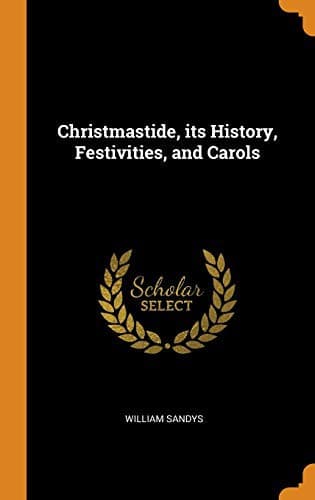
Christmastide: Its History, Festivities, and Carols — John Shaqi
Christmastide: Its History, Festivities, and CarolsSandys, William
History
Christmastide: Its History, Festivities, and Carols
Sandys, William
Christmas
In 1085, William, who was fond of magnificence, kept his Christmas with
great state at Gloucester, which was a favourite place with him and
his son William. He was either in a particular good humour, or wished
to perform what he might think an act of grace, and compensate the
severity with which he treated his conquered, or rather semi-conquered
new subjects, by showing favour to his own countrymen;—a sort of
liberal disposition of public gifts to family friends, that may be
seen occasionally even in modern times—so he gave bishoprics to three
of his chaplains, namely, that of London to Maurice, of Thetford
to William, and of Chester to Robert. There is a somewhat strange
regulation among the constitutions of Archbishop Lanfranc for the
government of the monks of his cathedral, which contain numerous
injunctions respecting washing and combing, and other matters that
would now surprise even a well-regulated boys’ school. On Christmas Eve
they are directed to comb their heads before they washed their hands,
while at other times they were to wash first, and comb afterwards. We
do not see the philosophy of this curious distinction.
William Rufus, the weak and profligate successor of the Conqueror, kept
the Christmas in state, like his father, and Henry the First followed
their example; even in 1105, which was “annus valde calamitosus,”
wherein he raised many tributes, he still kept his Christmas in state,
at Windsor. In 1116, he kept it at St. Albans, when the celebrated
monastery there was consecrated. In the Christmas 1126-7, which was
held at Windsor, anticipating the struggle for the crown that would
take place after his death, he assembled all the principal clergy and
nobles (David, king of Scots, being also present), and caused them to
swear that they would maintain England and Normandy for his daughter,
the Empress Matilda, after his death. In these early times, however, a
few oaths, more or less, were of little consequence; the “time whereof
the memory of man runneth not to the contrary” was of very short
date; a week sometimes making a man to forget utterly what he might
previously have sworn to; and the vicar of Bray would have been by no
means a reprehensible character.
King Stephen, after his accession, wore his crown and robes of state
like the former kings, and kept his Christmas at London; but about
the fifth year of his reign, the internal wars and tumults became and
continued of such magnitude, that during the remainder of this troubled
reign, the celebration of festivals was laid aside.
Public-domain text, read in full here on John Shaqi.
Reviews
Reviews
No reviews yet
Be the first to share your thoughts on this work.
Join the Discussion
Join the discussion
Sign in to leave a comment or review.
Sign InorCreate an account