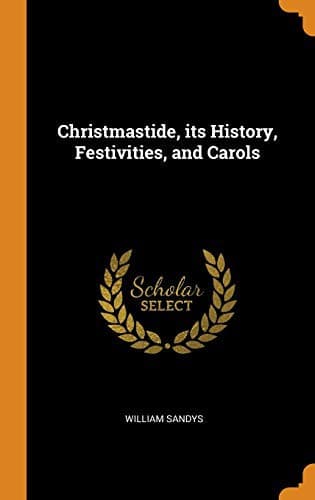
Christmastide: Its History, Festivities, and CarolsSandys, William
History
Christmastide: Its History, Festivities, and Carols
Sandys, William
Christmas
“Christmas is a time full honest,
Kyng Richard it honoured with gret feste;”
and an antiquary of course ought to consider these romances of equal
authenticity with the old chronicles; yet one cannot help thinking that
during Richard’s short reign, his captivity and his absence from his
kingdom must have interfered with his Christmas celebrations; in fact,
he, of the lion-heart, seems to have been more ornamental than useful
in the pages of history.
John celebrated the feast pretty regularly, but seems occasionally
to have selected a city or town for the purpose, where some great
personage was allowed to provide for the entertainment; as, for
instance, the celebrated Hubert de Burgh, at Canterbury, in 1203. In
1213, he kept his Christmas at Windsor with great festivity, and gave
many presents. He was accustomed to make a present to his chancellor,
every Christmas, of two marks of gold, according to ancient custom,
no doubt by way of New Year’s gift, and gave him half that value at
Easter and Whitsuntide. In 1214, he was keeping his Christmas at
Worcester, when he was informed of the resolution of the barons to
withdraw their allegiance, unless their claims were attended to. This
information being ill-suited for the festivities then in progress,
the king departed suddenly and shut himself up in the Temple; but the
barons went to him on the Epiphany of 1215 with their demands, to
which he promised a satisfactory answer at the ensuing Easter. The
dissensions between himself and his barons, ending in Magna Charta,
are well-known matters of history. In the following year the chief
barons of the realm were under sentence of excommunication, and the
city of London was under an interdict; but the citizens disregarded
this, kept open their churches, rang their bells, enjoyed their turtle
and whitebait (whatever the turtle and whitebait of that time might
have been), drank their hippocras, ale, mead, and claret or clarré,
and celebrated their Christmas with unusual festivity. The English had
long been celebrated for their pre-eminence in drinking; as Iago says,
“your Dane, your German, and your swag-bellied Hollander, are nothing
to your English.” They probably inherited the talent from the Saxons,
for their kings had their wine, mead, cyder, ale, pigment, and morat,
to which their Norman successors added claret or clarré, garhiofilac,
and hippocras. Morat was made from honey and mulberries; claret,
pigment, hippocras, and garhiofilac (so called from the girofle or
cloves contained in it), were different preparations of wine mixed with
honey and spices, no doubt very palatable; and hippocras particularly
was indispensable at all the great feasts. Garhiofilac was probably
made of white wine, and claret of red wine, as there is an order of
Henry the Third in existence, directing the keepers of his wines at
York, to deliver to Robert de Monte Pessulano two tuns of white wine
to make garhiofilac, and one tun of red wine to make claret for him at
Public-domain text, read in full here on John Shaqi.
Reviews
Reviews
No reviews yet
Be the first to share your thoughts on this work.
Join the Discussion
Join the discussion
Sign in to leave a comment or review.
Sign InorCreate an account