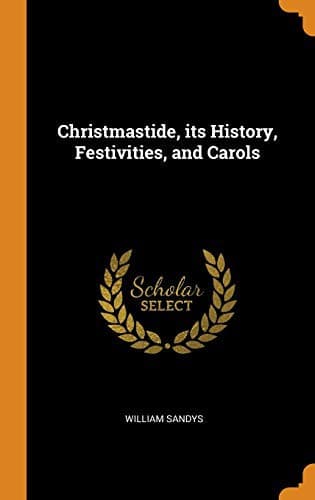
Christmastide: Its History, Festivities, and CarolsSandys, William
History
Christmastide: Its History, Festivities, and Carols
Sandys, William
Christmas
There are some particulars in the wardrobe accounts of the New Year’s
Gifts of Edward the Second, and also payments made to him to play
at dice at Christmas; a custom existing probably long before his
time, and certainly continued down to a comparatively recent period,
gambling at the groom-porter’s having been observed as late as the
time of George the Third. He also gave numerous gifts, being, as is
well known, of extravagant and luxurious habits. In his eleventh
year, especially, at Westminster, several knights received sumptuous
presents of plate from him, and the king of the bean (Rex Fabæ) is
mentioned as receiving handsome silver-gilt basins and ewers as New
Year’s Gifts. Two of the kings of the bean named, are, Sir William de
la Bech, and Thomas de Weston, squire of the king’s household. Edward
kept several stately Christmasses, and one at Nottingham in 1324,
with particular magnificence, glory, and resort of people. Even when
a prisoner at Kenilworth in 1326-7, he kept up a degree of state,
although his son, Edward the Third, then aged about sixteen years, was
crowned on Christmas Day, 1326, the queen-mother keeping open court,
with a great assembly of nobles, prelates, and burgesses, when it was
decided to depose the father, whose melancholy fate is well known.
Edward the Third became not only a great warrior, but, also, in many
respects, a great monarch, and his Christmasses, with other feasts,
were held with much splendour. One at Wells, where there were many
strange and sumptuous shows made to pleasure the king and his guests,
is particularly mentioned; but that at Windsor, in 1343-4, is by far
the most distinguished in history, as the king then renewed the Round
Table, and instituted the celebrated Order of the Garter, making St.
George the patron; whether from the circumstance of the countess of
Salisbury having dropped her garter (whence the old Welsh tune took its
name of Margaret has lost her garter), cannot now be distinctly proved;
but we may as well leave the balance in favour of gallantry. Suffice
it, that never has any order of knighthood enrolled such a succession
of royal, brave, and world-renowned characters. In 1347 at Guildford,
and 1348 at Ottford, in Kent, there were great revellings at Christmas.
In the first of these years, there were provided for the amusements of
the court, eighty-four tunics of buckram, of divers colours; forty-two
visors of different likenesses; twenty-eight crests; fourteen coloured
cloaks; fourteen dragons’ heads; fourteen white tunics; fourteen heads
of peacocks, with wings; fourteen coloured tunics, with peacocks’
eyes; fourteen heads of swans, with wings; fourteen coloured tunics of
linen; and fourteen tunics, coloured, with stars of gold and silver. In
the following year, quadrupeds were in the ascendancy, instead of the
feathered creation, and amongst the things mentioned in the wardrobe
expenses are, twelve heads of men, surmounted by those of elephants;
Public-domain text, read in full here on John Shaqi.
Reviews
Reviews
No reviews yet
Be the first to share your thoughts on this work.
Join the Discussion
Join the discussion
Sign in to leave a comment or review.
Sign InorCreate an account