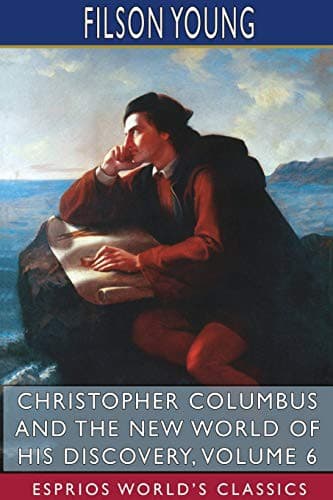
Christopher Columbus and the New World of His Discovery — Volume 6Young, Filson
History
Christopher Columbus and the New World of His Discovery — Volume 6
Young, Filson
America -- Discovery and exploration; Columbus, Christopher, 1451-1506
Another great conquest of the salt unknown taken place a few days before
Columbus sailed on his third voyage. The accidental discovery of the
Cape by Bartholomew Diaz in 1486 had not been neglected by Portugal; and
the achievements of Columbus, while they cut off Portuguese enterprise
from the western ocean, had only stimulated it to greater activity within
its own spheres. Vasco da Gama sailed from Lisbon in July 1497; by the
end of November he had rounded the Cape of Good Hope; and in May 1498,
after a long voyage full of interest, peril, and hardship he had landed
at Calicut on the shores of the true India. He came back in 1499 with a
battered remnant, his crew disabled by sickness and exhaustion, and half
his ships lost; but he had in fact discovered a road for trade and
adventure to the East that was not paved with promises, dreams, or mad
affidavits, but was a real and tangible achievement, bringing its reward
in commerce and wealth for Portugal. At that very moment Columbus was
groping round the mainland of South America, thinking it to be the coast
of Cathay, and the Garden of Eden, and God knows what other
cosmographical--theological abstractions; and Portugal, busy with her
arrangements for making money, could afford for the moment to look on
undismayed at the development of the mine of promises discovered by the
Spanish Admiral.
The anxiety of Columbus to communicate the names of things before he had
made sure of their substance received another rude chastisement in the
events that followed the receipt in Spain of his letter announcing the
discovery of the Garden of Eden and the land of pearls. People in Spain
were not greatly interested in his theories of the terrestrial Paradise;
but more than one adventurer pricked up his ears at the name of pearls,
and among the first was our old friend Alonso de Ojeda, who had returned
some time before from Espanola and was living in Spain. His position as
a member of Columbus's force on the second voyage and the distinction he
had gained there gave him special opportunities of access to the letters
and papers sent home by Columbus; and he found no difficulty in getting
Fonseca to show him the maps and charts of the coast of Paria sent back
by the Admiral, the veritable pearls which had been gathered, and the
enthusiastic descriptions of the wealth of this new coast. Knowing
something of Espanola, and of the Admiral also, and reading in the
despatches of the turbulent condition of the colony, he had a shrewd idea
that Columbus's hands would be kept pretty full in Espanola itself, and
that he would have no opportunity for some time to make any more voyages
of discovery. He therefore represented to Fonseca what a pity it would
be if all this revenue should remain untapped just because one man had
not time to attend to it, and he proposed that he should take out an
expedition at his own cost and share the profits with the Crown.
Public-domain text, read in full here on John Shaqi.
Reviews
Reviews
No reviews yet
Be the first to share your thoughts on this work.
Join the Discussion
Join the discussion
Sign in to leave a comment or review.
Sign InorCreate an account