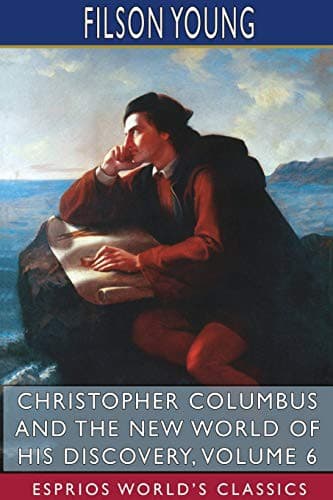
Christopher Columbus and the New World of His Discovery — Volume 6Young, Filson
History
Christopher Columbus and the New World of His Discovery — Volume 6
Young, Filson
America -- Discovery and exploration; Columbus, Christopher, 1451-1506
It was at this moment (September 5, 1499) that a diversion arose in the
rumour that four caravels had been seen off the western end of Espanola
and duly reported to the Admiral; and this announcement was soon followed
by the news that they were commanded by Ojeda, who was collecting
dye-wood in the island forests. Columbus, although he had so far as we
know had no previous difficulties with Ojeda, had little cause now to
credit any adventurer with kindness towards himself; and Ojeda's secrecy
in not reporting himself at San Domingo, and, in fact, his presence on
the island at all without the knowledge of the Admiral, were sufficient
evidence that he was there to serve his own ends. Some gleam of
Christopher's old cleverness in handling men was--now shown by his
instructing Roldan to sally forth and bring Ojeda to order. It was a
case of setting a thief to catch a thief and, as it turned out, was not
a bad stroke. Roldan, nothing loth, sailed round to that part of the
coast where Ojeda's ships were anchored, and asked to see his licence;
which was duly shown to him and rather took the wind out of his sails.
He heard a little gossip from Ojeda, moreover, which had its own
significance for him. The Queen was ill; Columbus was in disgrace;
there was talk of superseding him. Ojeda promised to sail round to San
Domingo and report himself; but instead, he sailed to the east along the
coast of Xaragua, where he got into communication with some discontented
Spanish settlers and concocted a scheme for leading them to San Domingo
to demand redress for their imagined grievances. Roldan, however, who
had come to look for Ojeda, discovered him at this point; and there
ensued some very pretty play between the two rascals, chiefly in
trickery and treachery, such as capturing each other's boats and
emissaries, laying traps for one another, and taking prisoner one
another's crews. The end of it was that Ojeda left the island without
having reported himself to Columbus, but not before he had completed his
business--which was that of provisioning his ships and collecting
dye-wood and slaves.
Public-domain text, read in full here on John Shaqi.
Reviews
Reviews
No reviews yet
Be the first to share your thoughts on this work.
Join the Discussion
Join the discussion
Sign in to leave a comment or review.
Sign InorCreate an account