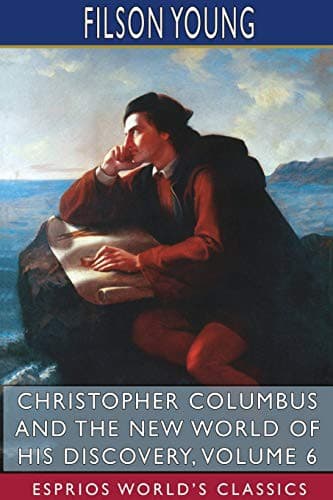
Christopher Columbus and the New World of His Discovery — Volume 6Young, Filson
History
Christopher Columbus and the New World of His Discovery — Volume 6
Young, Filson
America -- Discovery and exploration; Columbus, Christopher, 1451-1506
We must now turn back to Spain and try to form some idea of the way in
which the doings of Columbus were being regarded there if we are to
understand the extraordinary calamity that was soon to befall him. It
must be remembered first of all that his enterprise had never really been
popular from the first. It was carried out entirely by the energy and
confidence of Queen Isabella, who almost alone of those in power believed
in it as a thing which was certain to bring ultimate glory, as well as
riches and dominion, to Spain and the Catholic faith. As we have seen,
there had been a brief ebullition of popular favour when Columbus
returned from his first voyage, but it was a popularity excited solely by
the promises of great wealth that Columbus was continually holding forth.
When those promises were not immediately fulfilled popular favour
subsided; and when the adventurers who had gone out to the new islands on
the strength of those promises had returned with shattered health and
empty pockets there was less chance than ever of the matter being
regarded in its proper light by the people of Spain. Columbus had either
found a gold mine or he had found nothing--that was the way in which the
matter was popularly regarded. Those who really understood the
significance of his discoveries and appreciated their scientific
importance did not merely stay at home in Spain and raise a clamour; they
went out in the Admiral's footsteps and continued the work that he had
begun. Even King Ferdinand, for all his cleverness, had never understood
the real lines on which the colony should have been developed. His eyes
were fixed upon Europe; he saw in the discoveries of Columbus a means
rather than an end; and looked to them simply as a source of revenue with
the help of which he could carry on his ambitious schemes. And when, as
other captains made voyages confirming and extending the work of
Columbus, he did begin to understand the significance of what had been
done, he realised too late that the Admiral had been given powers far in
excess of what was prudent or sensible.
Public-domain text, read in full here on John Shaqi.
Reviews
Reviews
No reviews yet
Be the first to share your thoughts on this work.
Join the Discussion
Join the discussion
Sign in to leave a comment or review.
Sign InorCreate an account