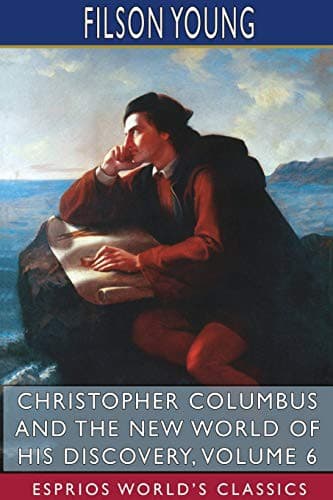
Christopher Columbus and the New World of His Discovery — Volume 6 — John Shaqi
Christopher Columbus and the New World of His Discovery — Volume 6Young, Filson
History
Christopher Columbus and the New World of His Discovery — Volume 6
Young, Filson
America -- Discovery and exploration; Columbus, Christopher, 1451-1506
Day after day the three ships lay motionless on the glassy water, with
wood-work so hot as to burn the hands that touched it, with the meat
putrefying in the casks below, and the water running from the loosened
casks, and no one with courage and endurance enough to venture into the
stifling hold even to save the provisions. And through all this the
Admiral, racked with gout, had to keep a cheerful face and assure his
prostrate crew that they would soon be out of it.
There were showers of rain sometimes, but the moisture in that baking
atmosphere only added to its stifling and enervating effects. All the
while, however, the great slow current of the Atlantic was moving
westward, and there came a day when a heavenly breeze, stirred in the
torrid air and the musical talk of ripples began to rise again from the
weedy stems of the ships. They sailed due west, always into a cooler and
fresher atmosphere; but still no land was sighted, although pelicans
and smaller birds were continually seen passing from south-west to
north-east. As provisions were beginning to run low, Columbus decided
on the 31st July to alter his course to north-by-east, in the hope of
reaching the island of Dominica. But at mid-day his servant Alonso
Perez, happening to go to the masthead, cried out that there was land in
sight; and sure enough to the westward there rose three peaks of land
united at the base. Here was the kind of coincidence which staggers
even the unbeliever. Columbus had promised to dedicate the first land
he saw to the Trinity; and here was the land, miraculously provided when
he needed it most, three peaks in one peak, in due conformity with the
requirements of the blessed Saint Athanasius. The Admiral was deeply
affected; the God of his belief was indeed a good friend to him; and he
wrote down his pious conviction that the event was a miracle, and
summoned all hands to sing the Salve Regina, with other hymns in praise
of God and the Virgin Mary. The island was duly christened La Trinidad.
By the hour of Compline (9 o'clock in the evening) they had come up with
the south coast of the island, but it was the next day before the
Admiral found a harbour where he could take in water. No natives were
to be seen, although there were footprints on the shore and other signs
of human habitation.
He continued all day to sail slowly along the shore of the island, the
green luxuriance of which astonished him; and sometimes he stood out from
the coast to the southward as he made a long board to round this or that
point. It must have been while reaching out in this way to the southward
that he saw a low shore on his port hand some sixty miles to the south of
Trinidad, and that his sight, although he did not know it, rested for the
first time on the mainland of South America. The land seen was the low
coast to the west of the Orinoco, and thinking that it was an island he
gave it the name of Isla Sancta.
Public-domain text, read in full here on John Shaqi.
Reviews
Reviews
No reviews yet
Be the first to share your thoughts on this work.
Join the Discussion
Join the discussion
Sign in to leave a comment or review.
Sign InorCreate an account