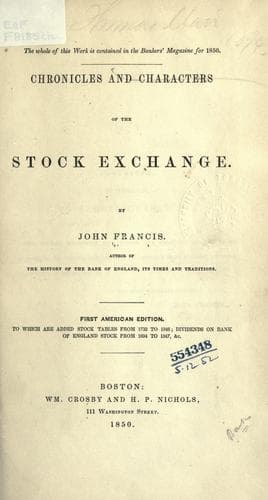
Chronicles and characters of the stock exchangeFrancis, John, of the Bank of England
History
Chronicles and characters of the stock exchange
Francis, John, of the Bank of England
Speculation; Stock Exchange (London, England)
The pulse of the people was feverish, and easily excited; and the
papers of the day display the intense anxiety which hung over the
public mind during the eventful years of 1814 and 1815. The prices
of the funds dropped and rose like a barometer. It is scarcely an
exaggeration to say, that they were regarded as an oracle; and, while
the public professed to disbelieve all Stock Exchange rumors, simply
because they were so, they continued to inquire the variations in the
price, and almost regarded them as a cause rather than a consequence.
The annals of the world contain no more exciting period. For years,
the English had seen battle after battle won by the great conqueror.
They had seen disciplined armies vanquished by raw levies; veteran
troops cut to pieces by young conscripts; and the prestige of his
name had haunted them for the fourth part of a century. To destroy
his power, they had submitted to painful privations; they had borne
with taxation which almost amounted to tyranny; they had levied loans
which enriched the few and impoverished the many.
The national debt had increased to 800 millions; and now the reward
had come, and the people read with undisguised and unlimited
pleasure, of field after field yielding to British prowess; of towns
stormed; of achievements which made them proud of the name they bore;
until that prophecy, which had been derided for years, became a
lasting fact; British troops paraded in triumph through the streets
of Paris; and men felt that their sufferings and their sorrows had
not been vain, but that the treasure they had lavished had reaped its
reward.
So important to our financial department was the close of this
war, that the decrease of the expenditure was at once declared to
be two millions per month; and, accustomed as the money power of
England had been to loan succeeding loan, the Stock Exchange could
scarcely understand the declaration of the Chancellor, that he
neither intended to ask for money, nor to touch the sinking fund.
The immediate effect of the battle of Waterloo on the funds was only
three per cent., nor was it until the capture of Napoleon became
positively known, that they rose to their previous price.
It is not unworthy of remark, that, from 1688 to 1814, sixty-three
years witnessed bloody and expensive wars, while only sixty-one years
were employed in recovering from the effects of so demoralizing a
system.
Public-domain text, read in full here on John Shaqi.
Reviews
Reviews
No reviews yet
Be the first to share your thoughts on this work.
Elsewhere in the archive
Join the Discussion
Join the discussion
Sign in to leave a comment or review.
Sign InorCreate an account