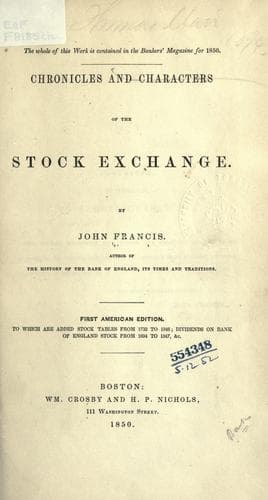
Chronicles and characters of the stock exchangeFrancis, John, of the Bank of England
History
Chronicles and characters of the stock exchange
Francis, John, of the Bank of England
Speculation; Stock Exchange (London, England)
The period at which the present narrative has arrived does not appear
ill adapted for a prospective and retrospective glance at a debt
which, in 121 years, has increased from £660,000 to £800,000,000,
which is the great problem of the day, and the great difficulty
of legislators. It has been seen that the debt was not increased
without strenuous opposition; and it need not be said that there were
alarmists a century ago, as there are alarmists now; that, as each
successive million was added, men were not wanting to declare the
ruin of the country; or that prophets were plentiful with omens of
evil. Bolingbroke wrote,—“It is impossible to look back without grief
on the necessary and unavoidable consequences of this establishment,
or without indignation on that mystery and iniquity which hath been
raised upon it, and carried on by means of it. Who can answer that
a scheme which oppresses the farmer, ruins the manufacturer, breaks
the merchant, discourages industry, and reduces fraud to a system,
which drains continually a portion of our national wealth away to
foreigners, and draws most perniciously the rest of that immense
property which was diffused among thousands into the pockets of the
few,—who can answer that such a scheme will always endure? The whole
art of stock-jobbing, the whole mystery of iniquity mentioned above,
rises from this establishment, and is employed about the funds; and
the main-springs which turn, or may turn, the artificial wheel of
credit, and make the paper estates that are fastened to it rise or
fall, lurk behind the veil of the treasury. That luxury which began
to spread after the restoration of Charles II. hath increased ever
since, from the growth of wealth among the stock-jobbers, from this
system. Nothing can be more certain than this,—that national luxury
and national poverty may in time establish national prostitution.
The immense wealth of particular men is a circumstance which always
attends national poverty, and is, in a great measure, the cause of
it. We may already apply to our country what Sallust makes Cato say
of Rome,—‘Public want and private wealth abound in all declining
states.’”
A reference to the tracts, pamphlets, and broadsides, which were
given to the world in the early part of the century, will prove that
public attention was constantly drawn to the growing difficulty; but
the writers committed the great error of pointing their darts at
the stock-jobbers. They persisted in regarding the consequence as
the cause; nor was it, Mr. Alison thinks, until after the peace of
Ryswick, that the great evil was regarded with any thing like alarm.
This gentleman, in his “Military Life of Marlborough,” draws the
following vivid picture, and the writer can confirm it from a careful
perusal of contemporary documents:—
Public-domain text, read in full here on John Shaqi.
Reviews
Reviews
No reviews yet
Be the first to share your thoughts on this work.
Elsewhere in the archive
Join the Discussion
Join the discussion
Sign in to leave a comment or review.
Sign InorCreate an account