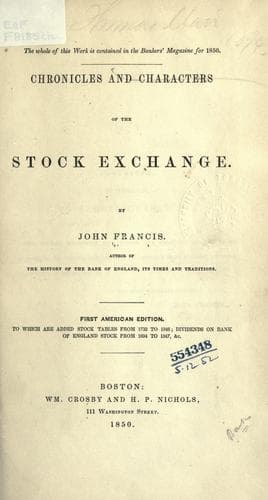
Chronicles and characters of the stock exchangeFrancis, John, of the Bank of England
History
Chronicles and characters of the stock exchange
Francis, John, of the Bank of England
Speculation; Stock Exchange (London, England)
“The finances of Great Britain,” he says, “as they were managed in
former times, could never have sustained the cost of such a war for
a tenth part of the time. But expense now seemed no obstacle to the
government. A new engine of surpassing strength had been discovered
for extracting capital out of the country; and the able statesmen
who had it in their hands felt it to be not less serviceable in
consolidating the internal power, than in meeting the external
expenses of the new dynasty.
“When this system first began, the nation was not sensible of the
important consequences to which it would lead. They thought it could
only be a temporary expedient; and that, though it might, perhaps,
lead to a few millions being added to the national debt, yet that
would be all. Though from the first, accordingly, its progress was
viewed with a jealous eye by the thinking few, it made but little
impression upon the unthinking many, before the peace of Ryswick.
But when the War of the Succession began, in 1702, and continued
without intermission, attended by daily and increasing expenditure,
for ten years, the apprehensions of a large part of the nation became
excessive. At the Revolution the national debt was £661,000; by 1710
it exceeded £50,000,000.
“The wars in which William was of necessity engaged, the loans
which they rendered unavoidable, and which the commercial wealth
of the nation enabled it to advance, and the great increase in the
expenditure of the Exchequer, all conspired to place a vast and
unprecedented amount of patronage in the hands of government. This
was systematically directed to buy off opposition in Parliament,
and secure a majority in the constituencies. Corruption, in every
possible form, from the highest to the lowest, was employed in all
parts of Great Britain, especially among the urban electors, and with
such success, that almost every measure of government passed without
difficulty through both Houses of Parliament. The nation had shaken
off the prerogatives of the crown, but they had fallen under the
domination of its influence. The gold of the Exchequer was found to
be more powerful than the penalties of the Star-Chamber.”
Public-domain text, read in full here on John Shaqi.
Reviews
Reviews
No reviews yet
Be the first to share your thoughts on this work.
Elsewhere in the archive
Join the Discussion
Join the discussion
Sign in to leave a comment or review.
Sign InorCreate an account