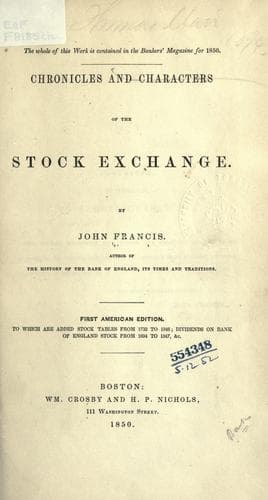
Chronicles and characters of the stock exchangeFrancis, John, of the Bank of England
History
Chronicles and characters of the stock exchange
Francis, John, of the Bank of England
Speculation; Stock Exchange (London, England)
9. That, for the effectual securing of the payment of such public
debts, for which there either is at present no provision, or the
provision made by Parliament appears deficient, all funds granted for
any term of years be made perpetual, until the principal and interest
of all the said public debts be fully paid off; and that the interest
of such public debts as at present have defective or no securities
be paid out of the yearly produce of the said funds; and that the
remainder only of such produce, over and above the interest of the
said public debts, be applied towards the sinking of the principal
money.
10. That provisions may be made by an excise on apparel, or some
other excise, sufficient to produce one million per annum in lieu of
the land-tax, till all the public debts are discharged.
In 1715, Mr. Asgill published his plan for the more speedy redemption
of all the perpetual funds; two millions were to be raised in
specie, and deposited in a bank, to support the circulation of
twenty millions of exchequer-bills at three per cent., with which
all the redeemable debts were to be paid off. As an annual interest
of £1,182,454 10_s._ 5_d._ was then paid for these redeemable debts,
and as the interest of the two millions to be borrowed at six per
cent., and of twenty millions of exchequer-bills at three per cent.,
amounted only to £720,000, the public would thus have acquired a
sinking fund of £462,454 10_s._ 5_d._
In 1719, Stephen Barbier proposed to pay the public debt. The plan
of this gentleman was to convert forty millions of the debt into
notes, bearing one per cent. less interest than the original fund,
which was thus to be converted; the conversion was only to take place
at the request of the creditor, who might thus at any time obtain
both principal and interest. These notes were to be current in all
pecuniary transactions, and were to be paid in specie, six months
after they were presented for payment.
Such were the chief propositions at the commencement of the
eighteenth century. It would be impracticable to follow the numerous
schemes which have since been propounded, but a few of the later
plans may not be uninteresting. In 1819, a proposition was made which
boldly grappled with the immediate difficulty. Estimating the entire
private property of the kingdom, on the lowest calculation, at two
thousand five hundred millions, it suggested that all such property,
including all claims on the government, in respect of money lent and
advanced, should be declared liable to a contribution of fifteen per
cent.
In 1821, a “practical scheme” appeared, the leading points of which
were,—
That all the annuities must be consolidated, viz.:—
The 3 per cents at 65
3½ ” 73½
4½ ” 81
5 ” 100
That an assessment of twenty per cent. be laid on all property and
funds so consolidated.
That an assessment of five per cent. be laid on private property not
in the British funds.
Public-domain text, read in full here on John Shaqi.
Reviews
Reviews
No reviews yet
Be the first to share your thoughts on this work.
Elsewhere in the archive
Join the Discussion
Join the discussion
Sign in to leave a comment or review.
Sign InorCreate an account