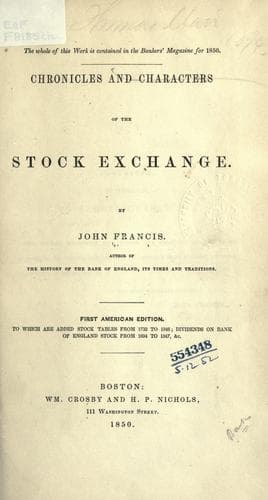
Chronicles and characters of the stock exchangeFrancis, John, of the Bank of England
History
Chronicles and characters of the stock exchange
Francis, John, of the Bank of England
Speculation; Stock Exchange (London, England)
That fixed property, except buildings, be valued at twenty years’
purchase.
That this assessment be converted into a redeemable income-tax, at
the option of the proprietor, at five per cent. per annum.
That a similar assessment, for the term of ten years, be levied on
net profits of trade and agriculture.
In 1827, it was proposed to pay one half the debt by an assessment
of twelve per cent. upon the entire capital of the country; and, in
1832, another “practical plan” was suggested; “to impose a loan of
twenty per cent. upon all the net real property, excepting those
whose possessions are less than £100; the amount to be paid either at
once, or by instalments, within five years.”
To impose a tax of five per cent. for one year upon all incomes of
not less than £100 a year, arising from profits of artists and other
professional men.
To abolish all internal taxes, excepting the land-tax.
Other propositions have appeared, but they have been entirely
disregarded. The evil day has been deferred, and will continue to
be so; but it affects all good citizens to bear in mind that it
must eventually arrive; and some future historian will record that
the ruin of England arose from the greatness of her national debt,
because her citizens were deficient in that abnegation of self which
alone could grapple with a great difficulty, save a great country,
and alleviate the sufferings of a patient and enduring people.
In 1817, the ministry debated the advisability of altering the mode
of registering the accounts of the national debt. Many complaints had
been made by bankers and merchants, of the long period employed by
the Bank of England in preparing for the payment of the dividends;
and they contended that six weeks were unnecessary; or, if necessary,
that some new method should be tried by which the annoyance might be
remedied.
The suggestion was taken into consideration, and the system of
debentures very generally debated. After much mature thought, it
was decided that, though the plan answered very well with foreign
securities, the English debt was too gigantic, and the plan would
involve too great a risk to be entertained. After much discussion
in the journals, and a few questions in the House, the idea was
abandoned; nor was it until thirty years from the above time, that
the objection of the bankers was met; and, by the arrangements of Mr.
William Ray Smee, now in operation at the Bank of England, the stocks
closed only three instead of six weeks.
CHAPTER XIII.
_Progress of Invention.—Public Roads.—Steam.—Duke of
Bridgewater.—Canals.—Railroads.—Thomas Gray, their
Pioneer.—His Difficulties.—Proposals for the Liverpool and
Manchester Railway.—Monopoly of the Canals.—Parliamentary
Inquiry.—Extraordinary Opinions of Witnesses.—The Claims of Thomas
Gray.—Value of Canal Property._
Public-domain text, read in full here on John Shaqi.
Reviews
Reviews
No reviews yet
Be the first to share your thoughts on this work.
Elsewhere in the archive
Join the Discussion
Join the discussion
Sign in to leave a comment or review.
Sign InorCreate an account