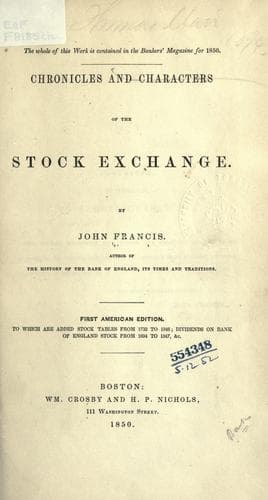
Chronicles and characters of the stock exchangeFrancis, John, of the Bank of England
History
Chronicles and characters of the stock exchange
Francis, John, of the Bank of England
Speculation; Stock Exchange (London, England)
At last the prejudices of the ignorant multitude were uprooted, and
the scientific few delighted. They who had gone to scoff remained to
praise; and an engineer, who had sneeringly said they had heard of
castles in the air, but now they were to see them realized, began to
wonder as much at his own opposition as at the simple grandeur of the
work he had derided. The chief business of the Duke’s agent was to
ride about the country, borrowing money on the promissory notes of
his Grace, whose bond for £500 was refused in the city, where great
purposes are little regarded unless they promise a great percentage.
In five years the attempt was crowned with success, and the effect
upon commerce became manifest. Liverpool received the manufactures of
Manchester at a cheaper rate, and Manchester was supplied with goods
from places hitherto comparatively inaccessible. The neighbouring
woods and vales were visited by the pale denizen of the factory on
the day of rest; and passengers were enabled to travel along that
canal which they owed to the patient endurance and undeviating
firmness of Francis, Duke of Bridgewater, and to the singular ability
of his unrivalled architect, to both of whom personal comfort and
public praise were nothing in comparison with the achievement of a
great idea.
But a new power was in progress, which was to realize all the visions
of a day-dreamer, and almost to annihilate both time and space. The
progress and development of railways is one of the most interesting
features in locomotion. About 1646, a Mr. Beaumont was ruined in
attempting to convey coals in carriages of a novel construction. The
necessity of some improvement in the conveyance of this article was,
therefore, thus early recognized. Thirty years afterwards, a saving
of thirty per cent. was effected by some tram-roads near Newcastle;
and as information spread, and the great dogma that _time is money_
began to be appreciated, further improvements were made. The wooden
roller of the wagon was changed for an iron wheel with cast-iron
rails. Plenty of claimants were found for this imperfect alteration,
although soon after it was necessary to adopt a rail fixed a few
inches above the ground. The next improvement was that which detached
the horse, and made him follow the wagon; and when the road was
constructed with two inclines, so that a descending train of loaded
coal might draw up an empty one, it was thought that all which human
ingenuity could effect had been achieved; and at this point it is
probable the rail would have remained, but for the great discovery of
steam-power, and its application to practical purposes. About 1760,
coeval with the introduction of iron rails, Watt entertained the idea
of employing steam as a moving power; but the design was abandoned;
nor was it till 1802 that the attention of engineers was devoted to
locomotive engines on railroads; when a patent was taken out, and
the principle tested with success at Merthyr Tydvil.[6]
Public-domain text, read in full here on John Shaqi.
Reviews
Reviews
No reviews yet
Be the first to share your thoughts on this work.
Elsewhere in the archive
Join the Discussion
Join the discussion
Sign in to leave a comment or review.
Sign InorCreate an account