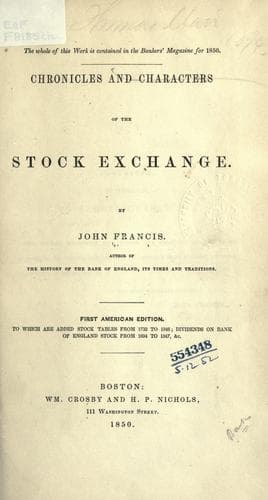
Chronicles and characters of the stock exchangeFrancis, John, of the Bank of England
History
Chronicles and characters of the stock exchange
Francis, John, of the Bank of England
Speculation; Stock Exchange (London, England)
When the Margate steamboat, with its six hours’ journey, superseded
the Margate hoy, which occupied almost as many days, the coach
proprietors, under the idea that Margate was their peculiar property,
and its visitors their particular prey, petitioned Parliament to
support the coaches, at the expense of the steamers. A century and
a half since, it was thought a great effort to run a coach between
Edinburgh and Glasgow in three days; it is now done in one hour;
and, only a century since, it occupied thirty-six hours in doing
that which is now accomplished in four. Although this tediousness of
transit was partially owing to what were by courtesy called roads,
it must be remembered that then, as now, there were the prejudices
of the people with which to contend; and, perfectly content with the
existing state of things, the country gentlemen were most strenuous
in their objections to the introduction of stage-coaches, on the plea
that their wives would lose their domestic habits through travelling
too frequently, and cease to be worthy housewives to the squirarchy
of England.[5]
The floor of the House of Commons was covered with memorials from
inkeepers and petitions from postboys. They merely indicated the
selfishness of the memorialists, tired the patience of the senators,
and wasted the time of the nation. But petitions in favor of “no
progress” were not the only mode of opposition. When the Lea was made
navigable, the farmers became furious, broke down the banks, and
injured the river. Still, with the progress of the nation, the roads
continued to improve. Transit became easier, more rapid, and cheaper;
and just as the world was congratulating itself on the perfection of
its highways, a new plan was proposed.
It soon became public, that a strange, eccentric nobleman, known as
the Duke of Bridgewater, had a queer crotchet in his head to create
a water-carriage, by cutting canals. It began also to be rumored,
that this same eccentric Duke, seriously determined to finish what he
had commenced, had reduced his personal expenses to £400 per annum,
and given up the remainder of his rental to carry out his project.
The many had no hesitation in declaring him insane; but his Grace
scarcely thought of their opinions as he proceeded with his task;
and the remarkable firmness of the Duke of Bridgewater, aided by
the great mind of John Brindley, his architect, produced an effect
which has already survived the pecuniary results at which he aimed.
It is impossible in the present volume to do justice to the resolute
character of the Duke, or to the obstacles overcome by the skill of
Mr. Brindley. Stupendous mounds of earth were removed, which seemed
to demand Titanic power; supplies of water were procured sufficient
to exhaust mountain springs and mountain rivulets; aqueducts were
built far above the surface of the river, rivalling those which
conveyed water to the Eternal City from the mountain recesses.
Public-domain text, read in full here on John Shaqi.
Reviews
Reviews
No reviews yet
Be the first to share your thoughts on this work.
Elsewhere in the archive
Join the Discussion
Join the discussion
Sign in to leave a comment or review.
Sign InorCreate an account