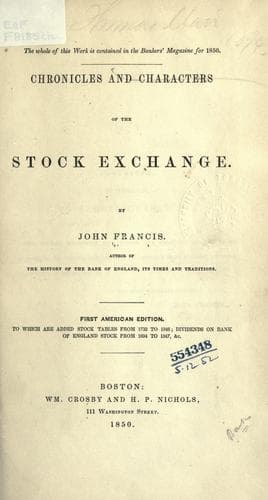
Chronicles and characters of the stock exchangeFrancis, John, of the Bank of England
History
Chronicles and characters of the stock exchange
Francis, John, of the Bank of England
Speculation; Stock Exchange (London, England)
The objections urged by the opponents of the railway were worthy
their cause. It was contended by them that canal conveyance was
quicker; that the smoke of the engines would injure the plantations
of gentlemen’s houses; and one witness, more imaginative than
perceptive, described the locomotives as “terrible things,” although,
on further questioning, he admitted he had never seen one. It was
boldly declared, that a gale of wind would stop the progress of
the carriage; that there would be no more practical advantage in a
railway than in a canal; that Mr. Stephenson was totally devoid of
common sense; that the plan was erroneous, impracticable, and unjust;
and that the tendency of the railway would be to increase the price
of carriage. It was declared to be based on fraud and folly; that
balloons and rockets were as feasible, and that the whole line would
be under water for two and three weeks in succession.
“It is quite idle and absurd,” said one, “to say the present scheme
can ever be carried into execution, under any circumstances, or
in any way.” “Whenever,” said another, with the authority of an
oracle, “Providence in Lancashire is pleased to send rain or a little
mizzling weather, expeditious it cannot be.” A third gave it as his
opinion, that no engine could go in the night-time, “because,” he
added, more Scripturally than soundly, “the night-time is a period
when no man can work!”
It was said that no one would live near a spot passed by the engines,
that no houses would let near a station; and that all property on the
line would be frightfully deteriorated. Not content, however, with
proving the impracticability of the plan, the most frivolous causes
were adduced to show why this, the grandest national project ever
brought forward, a project which has changed the face and features of
the land, the commerce of the country, and the social habits of the
rural population, should not be allowed to pass.
The public services of a railroad were put in competition with the
annoyance which an individual would receive from the smoke of the
engines coming within 250 yards of his house; and it was pathetically
asked, “Can any thing compensate for this?” Gentlemen objected
because it would injure their prospects, and land-owners because it
would injure their pockets! Pictures of ancient family residences
destroyed by the smoke were vividly drawn. The claims of unprotected
females and reverend gentlemen were strongly urged; and pathetic
representations were given of families, who had lived for centuries
in their ancestral home, leaving the dwelling-place of their youth,
and going to another part of the town.
“Mr. Stephenson,” it was boldly declared, “is totally devoid of
common sense. He makes schemes without seeing the difficulties.”
“Upon this shuffling evidence, we are called to pass the bill.” “It
is impossible to hold this changing Proteus in any knot whatsoever.”
“It is the greatest draught upon human credulity ever heard of.”
Public-domain text, read in full here on John Shaqi.
Reviews
Reviews
No reviews yet
Be the first to share your thoughts on this work.
Elsewhere in the archive
Join the Discussion
Join the discussion
Sign in to leave a comment or review.
Sign InorCreate an account