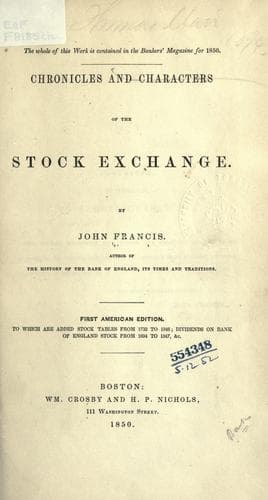
Chronicles and characters of the stock exchangeFrancis, John, of the Bank of England
History
Chronicles and characters of the stock exchange
Francis, John, of the Bank of England
Speculation; Stock Exchange (London, England)
“There is nothing,” said one, “but long sedgy grass to prevent the
train from sinking into the shades of eternal night.” “They cannot go
so fast as the canal,” said another. A third appealed to the pocket.
“If this bill succeeds, by the time railroads are set going, the
poor, gulled subscribers will have lost all their money; and, instead
of locomotive engines, they must have recourse to horses or asses,
not meaning to say which.” Those whose interests would be affected
decided that “locomotives could not succeed”; and numberless were
the sneers at the idea of engines galloping as fast as five miles an
hour. One sapient gentleman thought the trains might go at four miles
and a half in fine weather, but not more than two and a half in wet.
“When we set out with the original prospectus,” was the remark of the
counsel, “we were to gallop I know not at what rate. I believe it
was twelve miles an hour, with the aid of a devil in the form of a
locomotive sitting as postilion on the fore-horse, and an honorable
member sitting behind him to stir up the fire, and keep it up at full
speed. I will show they cannot go six. I may be able to show we shall
keep up with him by the canal.” “Thus, Sir, I prove that locomotive
engines cannot move at more than four miles and a quarter an hour;
and I show the scheme is bottomed on deception and fallacy.”
Turnpike trusts were to be ruined, and therefore railroads were not
to be forwarded; and it was deemed unanswerable to say that the
canal interests would be hurt by the rail. Though it was proved by
others that more money had been offered for land if the line passed
through than if it did not, it was of no importance in the eyes of
those who, blinded by selfishness, refused to be convinced. The
war-cry on one side was the venerable “vested rights”; on the other,
“progress.”
Men prosily and pathetically talked of tempting Providence by
travelling at the rate of twelve miles an hour. The fine breed of
English horses would be deteriorated, and our cavalry be worsted at
the first onset. The prosperity of a great community was said to be
involved in the contest; and the question whether a few miles of
railway would peril the welfare of the kingdom, was openly discussed.
Stable-boys joined in the contest, and urged the greatness of their
claim; the porters proved how important a class would be sacrificed
to so unimportant an end; and the clergy, alarmed lest the rustic
should neglect the Sunday sermon to see the passing train, added
to the number of petitions. A million horses were to be thrown
out of service, and eight millions of oat-growing acres to be
abandoned. Gentlemen with neither sense nor science wrote treatises
to demonstrate the danger of travelling more than ten miles an hour,
and, at the same time, left on record their want of sympathy with
crack-brained speculators.
Public-domain text, read in full here on John Shaqi.
Reviews
Reviews
No reviews yet
Be the first to share your thoughts on this work.
Elsewhere in the archive
Join the Discussion
Join the discussion
Sign in to leave a comment or review.
Sign InorCreate an account