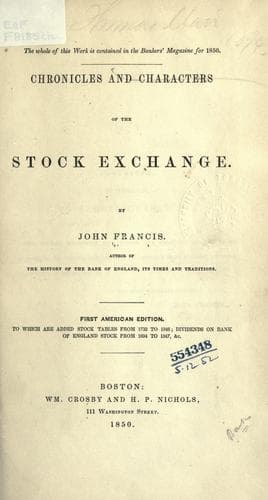
Chronicles and characters of the stock exchangeFrancis, John, of the Bank of England
History
Chronicles and characters of the stock exchange
Francis, John, of the Bank of England
Speculation; Stock Exchange (London, England)
Mismanagement marked the progress of the cause in Europe as in
Asia. Two excellent Swedish vessels were offered for £47,000. Time
was success, and, instead of purchasing vessels ready for action,
contracts were made with America for two frigates at £160,000. A
cavalry officer was appointed to superintend the naval department,
and in two months and a half five steamboats were to be placed
at the disposal of Lord Cochrane. “Within a few weeks,” said Mr.
Ellice, rather more pompously than to the purpose, “Lord Cochrane
will be at Constantinople, and burn the Turkish vessels at that
port. Cochrane will suffice for admiral and general. He will clear
Greece of the Turk.” “Give yourselves no further concern about the
matter,” said Sir Francis Burdett, speaking as familiarly of war as
of reform; “your country shall be saved.” But though Sir Francis
Burdett and Mr. Ellice said it, the country was not saved. After
spending £155,000 on two frigates, £50,000 more were required to
finish them. This was not forthcoming, and the vessels were seized.
All seemed anarchy and confusion. Schemes of the most extravagant
character were propounded. Three very important towns were to be
besieged and carried by one thousand men. A free press was to shed
light and lustre around. Improvements which were impracticable, and a
constitution which could not be carried, were promised.
During this unhappy period, the news of cities burned to the ground,
and forts stormed, of besieged places sacked after months of heroic
resistance, aroused the public; and a storm of indignation was poured
upon projectors, deputies, and proprietors. The flagrant enormities
of the management were exposed, the military projects discussed, the
financial artifices denounced; and attention was pointed, through the
report of the committee, at two, whose voices, loud in the cause of
Greece, were said to be louder in their own. Joseph Hume, a member
of the senate, and John Bowring, a linguist and a scholar, were
on the committee. Reports which touched the honor of both were in
free circulation. Political feeling, perhaps, prompted many of the
remarks; and the public press asserted that to which no honorable
man could submit. Mr. Merle, at a public meeting, said “he had been
told that certain portions of the Greek loan had been appropriated to
Mr. Hume; that those bonds had not been taken up; and that they had
afterwards been sold at a great loss to the Greek government.”
“Mr. Hume,” wrote a daily paper, “has been publicly accused of fraud
and hypocrisy, in throwing upon the Greek nation the loss which
attended a speculation of his own, while acting in the assumed
character of a friend to the cause.”
Public-domain text, read in full here on John Shaqi.
Reviews
Reviews
No reviews yet
Be the first to share your thoughts on this work.
Elsewhere in the archive
Join the Discussion
Join the discussion
Sign in to leave a comment or review.
Sign InorCreate an account