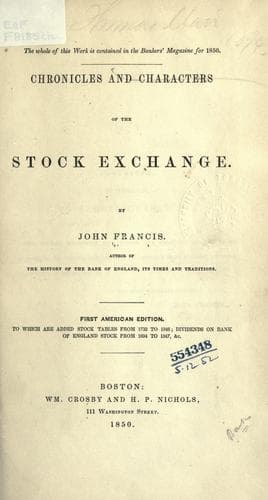
Chronicles and characters of the stock exchangeFrancis, John, of the Bank of England
History
Chronicles and characters of the stock exchange
Francis, John, of the Bank of England
Speculation; Stock Exchange (London, England)
It was proved that one million had been wasted in commissions and
military preparations, in Stock Exchange transactions and Stock
Exchange jobbing. The Greek deputies received allowances larger
than those paid to the diplomatic agents from great courts. Mr.
Hume, in his ardor for Greece, had £10,000 assigned him of the first
loan. The price fell sixteen per cent., and his ardor was said to
have fallen in proportion. Alarmed at a loss so great, the senator
endeavoured to release himself from the burden; but when he applied
to the deputies and contractors, he was met with the reply, that, had
the stock risen, he would not have returned the gain. The argument
was sound, but the head is obtuse when the purse is endangered; and
Mr. Hume—clear-headed generally—could not see the fairness of the
position. After some correspondence, the deputies agreed to take
it off Mr. Hume’s hands, at thirteen instead of sixteen per cent.
discount; thereby saving Mr. Hume £300 out of the loss of £1,600
which he first feared. In time, the Greek cause grew prosperous, the
stock rose to par, and Mr. Hume, with a singular power of perception
compared with his previous notions, claimed the £1,300 which he had
lost. The surprise of the deputies may be imagined, and they must
have had curious ideas of the way in which the friends of Greece
wished to serve her. Mr. Hume, however, was powerful; Mr. Hume was a
senator; and to Mr. Hume was accorded a privilege for which others
might have looked in vain. But a further question arose. Mr. Hume,
remarkable for the closeness of his calculations, discovered that £54
was due for interest. This he applied for, and this was granted.
The defence of Mr. Hume was comprised in the assertion, that, some of
his actions having been misinterpreted, because he was a proprietor
of stock, he had determined to part with it. The deputies offered to
save the friend of the cause so great a loss; and Mr. Hume thought
the conclusion at which they had arrived a sound one. After some
correspondence, they agreed to take his stock at thirteen per cent.
discount, the market price of sixteen per cent. being but nominal.
Mr. Hume wished to be relieved entirely; but this the deputies
declined. Shortly after, Mr. Hume was informed that these gentlemen
would pay him the sum he was deficient; and as he considered this as
fair, and not as a favor, he also considered he was entitled to the
interest. “The worst that any one can say of me,” concluded Mr. Hume,
“is, that I may have evinced an OVER-ANXIETY TO AVOID A PECUNIARY
LOSS.” Mr. Hume probably remembers his over-anxiety to the present
day.
Public-domain text, read in full here on John Shaqi.
Reviews
Reviews
No reviews yet
Be the first to share your thoughts on this work.
Elsewhere in the archive
Join the Discussion
Join the discussion
Sign in to leave a comment or review.
Sign InorCreate an account