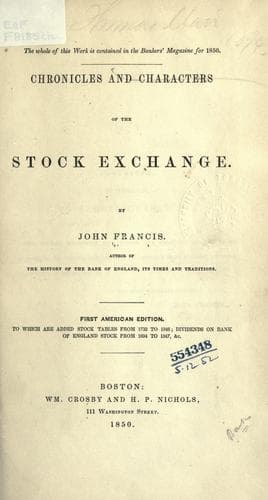
Chronicles and characters of the stock exchangeFrancis, John, of the Bank of England
History
Chronicles and characters of the stock exchange
Francis, John, of the Bank of England
Speculation; Stock Exchange (London, England)
He was, however, occasionally surpassed in cunning, and, on one
occasion, a great banker lent Rothschild a million and a half on
the security of consols, the price of which was then eighty-four.
The terms on which the money was lent were simple. If the price
reached seventy-four, the banker might claim the stock at seventy;
but Rothschild felt satisfied that, with so large a sum out of the
market, the bargain was tolerably safe. The banker, however, as much
a Jew as Rothschild, had a plan of his own. He immediately began
selling the consols received from the latter, together with a similar
amount in his own possession. The funds dropped; the Stock Exchange
grew alarmed; other circumstances tended to depress it; the fatal
price of seventy-four was reached; and the Christian banker had the
satisfaction of outwitting the Hebrew loan-monger.
But, if sometimes outwitted himself, there is little doubt he made
others pay for it; and, on one occasion, it is reported that his
finesse proved too great for the authorities of the Bank of England.
Mr. Rothschild was in want of bullion, and went to the governor to
procure on loan a portion of the superfluous store. His wishes were
met, the terms were agreed on, the period was named for its return,
and the affair finished for the time. The gold was used by the
financier, his end was answered, and the day arrived on which he was
to return the borrowed metal. Punctual to the time appointed, Mr.
Rothschild entered; and those who remember his personal appearance
may imagine the cunning twinkle of his small, quick eye, as, ushered
into the presence of the governor, he handed the borrowed amount in
bank-notes. He was reminded of his agreement, and the necessity for
bullion was urged. His reply was worthy a commercial Talleyrand.
“Very well, gentlemen. Give me the notes! I dare say your cashier
will honor them with gold from your vaults, and then I can return
you bullion.” To such a speech the only worthy reply was a scornful
silence.
One cause of his success was the secrecy with which he shrouded all
his transactions, and the tortuous policy with which he misled those
the most who watched him the keenest. If he possessed news calculated
to make the funds rise, he would commission the broker who acted
on his behalf to sell half a million. The shoal of men who usually
follow the movements of others, sold with him. The news soon passed
through Capel Court that Rothschild was bearing the market, and the
funds fell. Men looked doubtingly at one another, a general panic
spread, bad news was looked for, and these united agencies sunk the
price two or three per cent. This was the result expected; and other
brokers, not usually employed by him, bought all they could at the
reduced rate. By the time this was accomplished, the good news had
arrived, the pressure ceased, the funds arose instantly, and Mr.
Rothschild reaped his reward.[9]
Public-domain text, read in full here on John Shaqi.
Reviews
Reviews
No reviews yet
Be the first to share your thoughts on this work.
Elsewhere in the archive
Join the Discussion
Join the discussion
Sign in to leave a comment or review.
Sign InorCreate an account