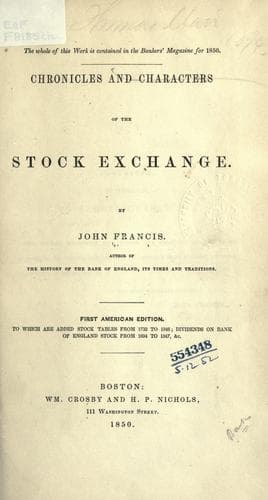
Chronicles and characters of the stock exchangeFrancis, John, of the Bank of England
History
Chronicles and characters of the stock exchange
Francis, John, of the Bank of England
Speculation; Stock Exchange (London, England)
Although Mr. Rothschild was commonly termed a merchant, his most
important transactions were in connection with the Stock Exchange. It
was here that his great decision, his skilful combinations, and his
unequalled energy, made him remarkable. At a time when the funds were
constantly varying, the temptation was too great for a capitalist
like Mr. Rothschild to withstand. His operations were soon noticed;
and when the money-market was left without an acknowledged head
by the deaths of Sir Francis Baring and Abraham Goldsmid,—for the
affairs of the latter were wound up, and the successors of the former
did not aim at the autocracy of the money-market,—the name of Nathan
Meyer Rothschild was in the mouths of all city men as a prodigy of
success. Cautiously, however, did the capitalist proceed, until he
had made a fortune as great as his future reputation. He revived all
the arts of an older period. He employed brokers to depress or raise
the market for his benefit, and is said in one day to have purchased
to the extent of four millions.
The name of Rothschild as contractor for an English loan made its
first public appearance in 1819. But the twelve millions for which
he then became responsible went to a discount; it was said, however,
that Mr. Rothschild had relieved himself from all liability before
the calamity could reach him. From this year his transactions
pervaded the entire globe. The Old and the New World alike bore
witness to his skill; and with the profits on a single loan he
purchased an estate which cost £150,000. Minor capitalists, like
parasitical plants, clung to him, and were always ready to advance
their money in speculations at his bidding. Nothing seemed too
gigantic for his grasp; nothing too minute for his notice. His mind
was as capable of contracting a loan for millions, as of calculating
the lowest possible amount on which a clerk could exist. Like too
many great merchants, whose profits were counted by thousands, he
paid his assistants the smallest amount for which he could procure
them. He became the high-priest of the temple of Janus; and the
coupons raised by the capitalist for a despotic state were more than
a match for the cannon of the revolutionist.[8] From most of the
speculations of 1824 and 1825, Mr. Rothschild kept wisely aloof. The
Alliance Life and Fire Assurance Company, which owes its origin to
this period, was however, produced under his auspices; and its great
success is a proof of his forethought. None of the loans with which
he was connected were ever repudiated; and when the crash of that
sad period came, the great Hebrew looked coolly and calmly on, and
congratulated himself on his caution. At his counting-house a fair
price might be procured for any amount of stock which, at a critical
time, would have depressed the public market; and it was no uncommon
circumstance for brokers to apply at the office of Mr. Rothschild,
instead of going in the Stock Exchange.
Public-domain text, read in full here on John Shaqi.
Reviews
Reviews
No reviews yet
Be the first to share your thoughts on this work.
Elsewhere in the archive
Join the Discussion
Join the discussion
Sign in to leave a comment or review.
Sign InorCreate an account