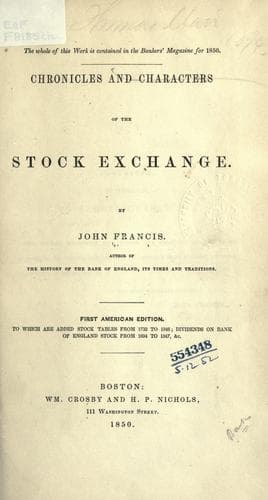
Chronicles and characters of the stock exchangeFrancis, John, of the Bank of England
History
Chronicles and characters of the stock exchange
Francis, John, of the Bank of England
Speculation; Stock Exchange (London, England)
are honorable in spite of the temptations which surround them; it is
consulted by chancellors, and taken into the councils of ministers;
peace or war hangs upon its fiat; and yet the Stock Exchange is
seldom named, out of the city, but with contempt; and a Stock
Exchange man is, like the moneyed man in the early reign of William,
despised by the landed, and looked down upon by the mercantile,
aristocracy. One reason, perhaps, for this is, that the great mass
of their transactions are without the pale of the law. All their
time-bargains—and the Stock Exchange might close to-morrow if these
were abolished—are illegal. They are, strictly speaking, gambling
dealings, which our judicature refuses to recognize; and the dealers
are gamblers, whom the legislature will not acknowledge.
The tricks which are resorted to are numerous. The penniless
speculator can enter into transactions which may retrieve his
fortunes, or consolidate his ruin. It is said to be a not uncommon
trick for two persons to agree together in the following manner:—one
buys and the other sells for the account to the largest amount for
which each can procure credit. One must lose, and the other must
gain. One becomes a millionnaire, the other a defaulter. The former
receives a large amount, the latter is declared on the blackboard.
A division of the spoils is afterwards privately effected; and the
gainer pursues his avocation in the funds, while the loser becomes a
prosperous gentleman.
The public cannot be too decidedly warned against the dangers to
which they may be exposed in legitimate transactions. On one
occasion, a merchant having requested his broker to purchase a
certain amount of stock, and having concluded the business, was
surprised in the evening to hear his broker announced as a visitor.
Some remark being made, the latter stated that a dispute had arisen
with the jobber about the price which was in the receipt, and he
should be glad to take it with him as an evidence of his correctness.
Knowing that a stock receipt is in itself of no value, the buyer
readily complied. His visitor thanked him, and from that moment was
never heard of. The receipt was false, the names were forged; and,
secure in the possession of all evidence against him, the broker
sought a foreign land in which to enjoy his unrighteous gains.
If the morals of the Stock Exchange be as described, its manners are
as curious. It is not long since the papers reported a limb broken
in sport. The writer has perused in the journals occasional duels
which have arisen from the “fun” of the members; and the courtesies
of life are wanting if a stranger ventures among them. When this is
the case, instead of the bearing of gentlemen, the first discoverer
of the intruder cries out, “Fourteen hundred fives!” and a hundred
voices reëcho the cry. Youth or age is equally disregarded; and the
following description of what occurred to an unhappy visitor will
attest the truth of that which has been asserted:—
Public-domain text, read in full here on John Shaqi.
Reviews
Reviews
No reviews yet
Be the first to share your thoughts on this work.
Elsewhere in the archive
Join the Discussion
Join the discussion
Sign in to leave a comment or review.
Sign InorCreate an account