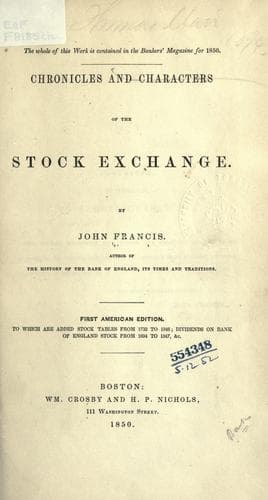
Chronicles and characters of the stock exchange — John Shaqi
Chronicles and characters of the stock exchangeFrancis, John, of the Bank of England
History
Chronicles and characters of the stock exchange
Francis, John, of the Bank of England
Speculation; Stock Exchange (London, England)
The English funds were assuming a greatness they have ever since
maintained. The Hebrew capitalist, who came over with William,
had increased the importance of the jobbers by joining them. The
English merchant—even at this early period—found that money might
be gained in the new operation; and ’Change Alley, so well known in
Parliamentary debates and the correspondence of the time as “the
Alley,” was for a century the centre of all dealings in the funds.
Here assembled the sharper and the saint; here jostled one another
the Jew and the Gentile; here met the courtier and the citizen; here
the calmness of the gainer contrasted with the despair of the loser;
and here might be seen the carriage of some minister, into which the
head of his broker was anxiously stretched to gain the intelligence
which was to raise or depress the market. In one corner might be
witnessed the anxious, eager countenance of the occasional gambler,
in strong contrast with the calm, cool demeanor of the man whose
trade it was to deceive. In another the Hebrew measured his craft
with that of the Quaker, and scarcely came off victorious in the
contest; while in one place, appropriated to him, stood the founder
of hospitals, impressing with eagerness upon his companion the
bargain he was about to make in seamen’s tickets.
It was soon felt practically that the air of England is cold and its
climate variable. The more respectable among the jobbers, therefore,
gathered beneath the walls of one of those coffee-houses which formed
so marked a feature of London life in the eighteenth century, until
the chance became a customary visit, and the coffee-house known as
Jonathan’s became the regular rendezvous of all the dealers in stock,
and consequently the scene of transactions as extensive as any the
world ever witnessed.
In 1701, the character of those who met in ’Change Alley was not
very enviable. It was said, and said truly, that they undermined,
impoverished, and destroyed all with whom they came in contact. “They
can ruin men silently,” says a writer of the period, with great
vehemence; “undermine and impoverish, fiddle them out of their money,
by the strange, unheard-of engines of interest, discount, transfers,
tallies, debentures, shares, projects, and the devil and all of
figures and hard names.”
Public-domain text, read in full here on John Shaqi.
Reviews
Reviews
No reviews yet
Be the first to share your thoughts on this work.
Join the Discussion
Join the discussion
Sign in to leave a comment or review.
Sign InorCreate an account