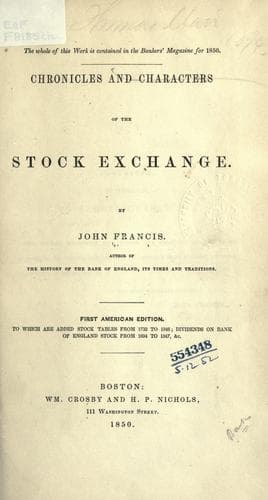
Chronicles and characters of the stock exchangeFrancis, John, of the Bank of England
History
Chronicles and characters of the stock exchange
Francis, John, of the Bank of England
Speculation; Stock Exchange (London, England)
2. That the stock-jobbers, who are guilty of the practices I am
going to detect, are eventually traitors to King George, and to his
government, family, and interest, and to their country, and deserve
to be used at least as confederates with traitors, whenever there are
any alarms of invasions, rebellions, or any secret practices against
the government, of what kind soever.
This is a black charge, and boldly laid, and ought therefore to be
effectually made out, which shall be the work of a few pages in the
following sheets.
1. I lay down this as a rule, which I appeal to the laws of reason
to support, that all those people who, at a time of public danger,
whether of treasonable invasion from abroad, or traitorous attempts
to raise insurrections at home, shall willingly and wittingly abet,
assist, or encourage the traitors invading or rebelling, are equally
guilty of treason.
2. All those who shall endeavour to weaken, disappoint, and disable
the government in their preparations, or discourage the people in
their assisting the government to oppose the rebels or invaders, are
guilty of treason.
All that can be alleged in contradiction to this,—and perhaps that
could not be made out neither,—is, that they are not traitors within
the letter of the law; to which I answer, if they were, I should not
satirize them, but impeach them. But if it appears that they are as
effectually destructive to the peace and safety of the government,
and of the king’s person and family, as if they were in open war with
his power, I do the same thing, and fully answer the end proposed.
As there are many thieves besides housebreakers, highwaymen, lifters,
and pickpockets, so there are many traitors besides rebels and
invaders, and, perhaps, of a much worse kind; for, in a dispute
between a certain lord and a woman of pleasure in the town, about the
different virtue of the sexes, the lady insisted that the men were
aggressors in the vice, and that, in plain English, if there were no
whore-masters, there would be no whores; so, in a word, if there were
no parties at home, no disaffection, no traitors among ourselves,
there would be no invasions from abroad.
Now, I will suppose for the purpose only, that the people I am
speaking of were not disaffected to the government; I mean, not
originally and intentionally pointing their intention at the
government; nay, that they are hearty Whigs, call them as we please;
yet, if it appear they are hearty knaves, too, will do any thing
for money, and are, by the necessity of their business, obliged, or
by the vehement pursuit of their interest, that is to say, of their
profits, pushed upon things as effectually ruinous and destructive to
the government, as the very buying arms and ammunition by a protest
Jacobite, in order to rebellion, could be, are they not traitors even
in spite of principle, in spite of the name of Whig; nay, in spite of
a thousand meritorious things that might otherwise be said of them,
or done of them?
Public-domain text, read in full here on John Shaqi.
Reviews
Reviews
No reviews yet
Be the first to share your thoughts on this work.
Elsewhere in the archive
Join the Discussion
Join the discussion
Sign in to leave a comment or review.
Sign InorCreate an account