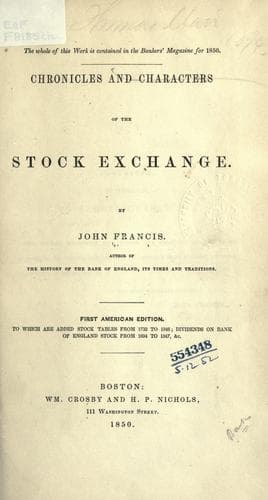
Chronicles and characters of the stock exchangeFrancis, John, of the Bank of England
History
Chronicles and characters of the stock exchange
Francis, John, of the Bank of England
Speculation; Stock Exchange (London, England)
A gunsmith makes ten thousand firelocks in the Minories, the honest
man may be a Whig, he designs to sell them to the government to lay
up in the tower, or to kill Spaniards, or any of the rest of the
king’s enemies; a merchant comes and buys some of them, and says they
are for the West Indies, or to sell into France. But upon inquiry, it
appears they are bought for rebellion; the undesigning gunsmith comes
into trouble, of course, and it will be very hard for him to prove
the negative, that when he has furnished the rebels with arms, he had
no share in the rebellion.
To bring this home to the case in view, who were the men who, in
the late hurry of an expected invasion, sunk the price of stock
fourteen or fifteen per cent.? Who were the men that made a run upon
the Bank of England, and pushed at them with some particular pique,
too, if possible, to have run them down, and brought ’em to a stop
of payment? And what was the consequences of these things? Will
they tell us that running upon the bank, and lowering the stocks,
was no treason? We know that, literally speaking, those things are
no treason. But is there not a plain constructive treason in the
consequences of it? Is not a wilful running down the public credit,
at a time when the nation is threatened with an invasion from abroad,
and rebellion at home? Is not this adding to the terror of the
people? Is not this disabling the government, discouraging the king’s
friends, and a visible encouragement of the king’s enemies? Is not
all that is taken from the credit of the public, in such an occasion,
added to the credit of the invasion? Does not every thing that
weakens the government strengthen its enemies? And is not every step
that is taken in prejudice of the king’s interest a step taken in aid
of the designed rebellion? The kindest thing that can be said of a
certain triumvirate of jobbers, whose hands have been deepest in this
part of the work, and who, indeed, had more obligations upon them
than any other men in the town, to have assisted the public interest
and advanced the credit of the nation, is, that they did not think
what they did, and that this excuse may not serve them another time,
I may soon furnish them with an anatomy of some of the conduct of
that little body of Number Three, that when they see their mistakes
with the eyes that other men see them, they may at their leisure give
a better turn to the measures of unbounded avarice.
Public-domain text, read in full here on John Shaqi.
Reviews
Reviews
No reviews yet
Be the first to share your thoughts on this work.
Elsewhere in the archive
Join the Discussion
Join the discussion
Sign in to leave a comment or review.
Sign InorCreate an account