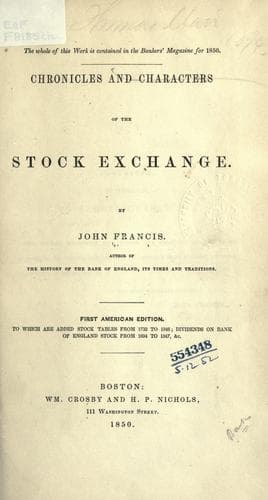
Chronicles and characters of the stock exchangeFrancis, John, of the Bank of England
History
Chronicles and characters of the stock exchange
Francis, John, of the Bank of England
Speculation; Stock Exchange (London, England)
During that period, which, now a romantic, was then a terrible
reality, when it was known, in 1715, that the best families in
the North of England had assembled in arms to change the dynasty,
no pains were spared by the jobbers to procure correct and to
disseminate false intelligence: and it was with mingled feelings of
alarm and pity that the inhabitants of a small town between Perth
and the seaport of Montrose—where James embarked after his unhappy
expedition—saw a carriage and six, travelling with all the rapidity
which the road would allow. It was known that the rebel army was
dispersed; that its chiefs were scattered; and that the unfortunate
Stuart was wandering through the country, with life and liberty alike
endangered. It excited, therefore, no surprise in the village when
the carriage was surrounded, and the apparent prize conveyed with
great ostentation towards London. Letters soon reached the city that
the fugitive Stuart was taken, and the letters were confirmed by the
story related, which quickly reached London. The funds of course
rose, and the inventors of the trick laughed in their sleeves as
they divided the profit. By this time the jobbers must have reached
a somewhat high position, as, the same year, one Quare, a Quaker
and a celebrated watchmaker in ’Change Alley, having successfully
speculated in the shares and funds with which it abounded, was
of sufficient importance to invite to the marriage-feast of his
daughter, Sarah Jennings, Duchess of Marlborough, and the Princess
of Wales, who, with three hundred guests of distinction, graced the
wedding entertainment.
But ’Change Alley was notorious for other dealings than those in
the funds. When that desperate struggle for power occurred between
the old and new East India Company; when their varying claims
were on every man’s tongue, and their bribes in every man’s hand;
the election of a member of Parliament was an affair of moment.
The partisans of each Company sided with their friends; bought
boroughs; shed their money lavishly and largely; used every art that
self-interest could devise; and so extensive was the interference
of the brokers, that the only question heard in ’Change Alley was,
“Is he for the New or the Old Company?” It was the touchstone of
a principle more sacred than the Hanoverian succession, and more
important than England and Hanover united. It was probably found
profitable; and it was said in 1720, that elections for members
of Parliament came to market in ’Change Alley as currently as
lottery-tickets.
Public-domain text, read in full here on John Shaqi.
Reviews
Reviews
No reviews yet
Be the first to share your thoughts on this work.
Join the Discussion
Join the discussion
Sign in to leave a comment or review.
Sign InorCreate an account