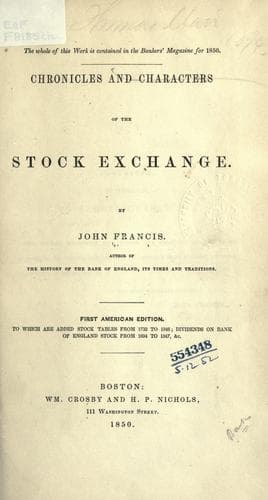
Chronicles and characters of the stock exchangeFrancis, John, of the Bank of England
History
Chronicles and characters of the stock exchange
Francis, John, of the Bank of England
Speculation; Stock Exchange (London, England)
A proposition was made in 1737, by the same gentleman, to reduce the
interest on the national debt from four to three per cent. Nothing
could be more just than this, as the public might either receive
their principal in full, or one per cent. less interest. The House
was at first disposed to entertain the proposal with the fairness it
merited; but the moneyed men rose in a body, and Sir Robert Walpole,
fearing to disoblige them, fearing to lose those votes on which
he had hitherto relied, and envying also the popularity Sir John
might acquire, determined to crush the scheme. He interested the
king and queen; he employed his ministerial power; he intimidated
some, he bribed others, he puzzled and persuaded more; until,
his purpose being effected, the bill—than which nothing could be
more reasonable—was rejected. The popular feeling attributed this
opposition to the royal family, who possessed great funded property;
but to popular feeling, unless it rose to a storm, as with the Excise
Bill, Sir Robert Walpole was very indifferent.
In the same year, an inquiry being instituted into the books of
the Bank of England, it was calculated that ten millions were held
by foreigners in the English funds; a remarkable proportion of the
amount at which the national debt then stood.
In the reign of George II. a new mode of raising loans was adopted.
Instead of varying the interest according to the state of the
money-market, the rate was fixed from three to five per cent., and
the subscribers remunerated by an additional amount of stock. It was
the first public announcement that the debt was perpetual; and has
made the present principal two fifths more than the sum originally
advanced. In the earlier history of borrowing, the government named
its own terms; and as this generally afforded a profit, the loan
was soon filled. If, however, the ministerial proposals were not
sufficiently liberal, the executive altered the terms to the real
value of money; and it is by no means an uninstructive fact, that
it was found in 1748, after a close calculation, that for thirty
previous years land had produced a higher interest than the funds.
Although an act had been passed by which it was declared illegal for
one individual to have more than twenty lottery-tickets allowed him,
it soon became notorious that the rule was flagrantly and frequently
violated. Manasseh Lopez, whose dealings on the Stock Exchange
entitled him to be termed a leader, had bribed the commissioners to
permit an indirect violation of the law, by accepting a long list of
feigned names as candidates for tickets. He was prosecuted by the
Attorney-General, and sued in the Court of King’s Bench. A fine of
one thousand pounds was awarded as punishment; but as he had made
more than fifty times the amount, it might be regarded as a very
successful speculation.
Public-domain text, read in full here on John Shaqi.
Reviews
Reviews
No reviews yet
Be the first to share your thoughts on this work.
Join the Discussion
Join the discussion
Sign in to leave a comment or review.
Sign InorCreate an account