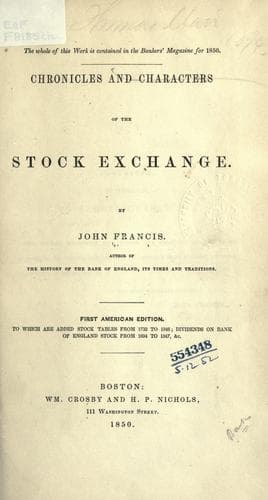
Chronicles and characters of the stock exchangeFrancis, John, of the Bank of England
History
Chronicles and characters of the stock exchange
Francis, John, of the Bank of England
Speculation; Stock Exchange (London, England)
The first reduction in the interest of the national debt—from four
to three per cent.—was effected in 1750, and was received with a
storm of indignation similar to that which arose in 1737, on the mere
attempt. Sir John Barnard, to whom every thing connected with the
funds was of importance, is mentioned as having proposed it to Mr.
Pelham, who brought it forward in the House of Commons. The best men
in the city protested against so bold a measure, and the foes of the
minister encouraged the opposition of the fundholder; his friends
overwhelmed him with entreaties to withdraw the motion; and every
engine which could be brought into operation by the moneyed interest
was employed. Reasons which time has since repudiated, fallacies
which almost repudiated themselves, evils which had no existence save
in the brain of the prophet, were freely circulated. It was said that
the landed gentry and the noble families of England would be ruined,
and their children would become beggars; that the interest of younger
sons’ portions would not enable them to associate with the cooks and
coachmen of their elder brothers; and that merchants, shopkeepers,
and tradesmen would be ruined. The farmers would lose their farms;
families would be undone; and such a deluge of distress be brought
upon all ranks, that the consequences would be fatal to that “free
and happy constitution” which has been so often ruined in the brains
and in the prophecies of partisans.
Its first reception was so lukewarm by the minister’s friends, and
the opinions of the people so strong, that, coupled with the previous
failure of a similar measure, its miscarriage was confidently
calculated. “Mr. Pelham,” says the flippant chronicler of the times,
“who has flung himself entirely into Sir John Barnard’s hands, has
just miscarried in a scheme for the reduction of interest, by the
intrigues of the three great companies and other usurers.” Horace
Walpole mistook the voice of his little circle for the voice of the
country. The scheme did not miscarry; and it is remarkable that this,
the first reduction in the interest of the national debt, was planned
in a most masterly manner, and reflected great honor upon Sir John
Barnard. A loss of one per cent. upon the income of an annuitant is
important, and acts prejudicially upon all with limited means. To
obviate this evil, if the fundholder declined receiving his capital,
the interest was reduced from 1750 to 1757 only one half per cent.,
3½ being paid during that period; after 1757 it was reduced the
remaining half per cent. The great resources of England have ever
been regarded with wonder by foreign nations; and they looked with
astonishment on the power of a people which, after a heavy war and an
increased debt, enabled the state to repay its creditors or reduce
its interest.
Public-domain text, read in full here on John Shaqi.
Reviews
Reviews
No reviews yet
Be the first to share your thoughts on this work.
Join the Discussion
Join the discussion
Sign in to leave a comment or review.
Sign InorCreate an account