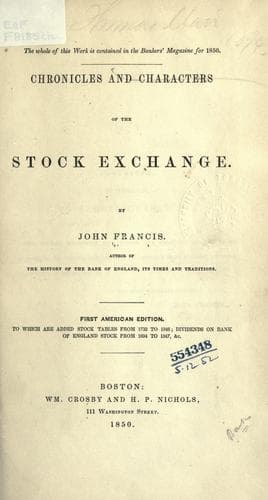
Chronicles and characters of the stock exchangeFrancis, John, of the Bank of England
History
Chronicles and characters of the stock exchange
Francis, John, of the Bank of England
Speculation; Stock Exchange (London, England)
The name of Sir John Barnard, the father of the city, its honest
representative for six sessions, the remodeller of the Stock
Exchange, and the reducer of the interest on the national debt,
occupies a prominent place in all questions connected with the funds.
Born of the same persuasion as William Penn, he retained during life
much of the simple honesty of the creed he originally professed; and
even Sir Robert Walpole respected him, although he was constant in
his opposition to bad measures, and could never be bought nor bribed.
“I address myself to you, Mr. Speaker, and not to your chair,” he
said, when Sir Robert Walpole, secure in a majority, withdrew the
attention of the Speaker; “I will be heard; and I call that gentleman
to order.” Lord Chatham gave him, half in jest and half in earnest,
the proud title which was afterwards appropriated to himself, of “the
great Commoner.” His pride was indomitable. The members of the Stock
Exchange, who were always spoken of with great contempt by Sir John,
thoroughly detested him, and greatly helped to fan the unpopularity
which fell upon him when he opposed public feeling, as, with a most
unbending integrity, he invariably did, if his conscience prompted.
“He grew,” said Horace Walpole on one occasion, “almost as unpopular
as Byng.” On commercial subjects his opinion was greatly regarded.
When any remarkable feature in financial politics occurred, the town
echoed with, “What does Sir John say to this? What is Sir John’s
opinion?” And he had the honor of refusing the post of Chancellor
of the Exchequer in 1746. It is somewhat at variance with the proud
character of the man, that, from the time his statue was erected in
the Royal Exchange, he never entered the building, but transacted
his business in the front. The blood of Sir John Barnard yet flows
in the veins of some of the best houses in the commercial world, his
son having married the daughter of a gentleman known in contemporary
history as “the great banker, Sir Thomas Hankey.”
CHAPTER VI.
_Origin of New Loans.—Fraud of a Stock-broker.—East India
Stock.—Sketch of Sampson Gideon, the great Jew Broker.—East
India Company.—Restriction of its Dividends.—Liberality to its
Clerks.—Important Decision.—Robbery at Jonathan’s.—Curious
Calculation concerning the National Debt._
Public-domain text, read in full here on John Shaqi.
Reviews
Reviews
No reviews yet
Be the first to share your thoughts on this work.
Join the Discussion
Join the discussion
Sign in to leave a comment or review.
Sign InorCreate an account