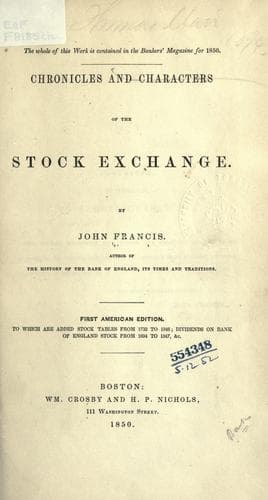
Chronicles and characters of the stock exchangeFrancis, John, of the Bank of England
History
Chronicles and characters of the stock exchange
Francis, John, of the Bank of England
Speculation; Stock Exchange (London, England)
The Spanish war, and the war of the Austrian succession, was the
origin of the next increase of the national debt. It was alleged
that the commerce and the merchants of Great Britain were injured
by the Spaniards; that the subjects of England were sent to the
Spanish mines; and though one remonstrance followed another to the
court of Madrid, promises were more plentiful than performances from
the haughty Spaniard. The people were excited to believe that their
honor was insulted; a dramatic exhibition was made at the bar of the
House of Commons; and this war, partly to please the populace, partly
to heal the wounded national pride, and partly to secure British
subjects from the right of search in American seas, was openly
declared in 1739. The heralds were attended in their progress by the
chiefs of the opposition, and the Prince of Wales drank success to
England at Temple Bar; but Sir Robert Walpole, as he heard the merry
peal from the city steeples, muttered, “They may ring their bells
now, they will wring their hands before long.”
The misfortunes with which the campaign opened justified the
minister’s prophecy, and the war was violently attacked in the
House; but the majority of Sir Robert was an irresistible argument,
and calamity continued to mark the progress of the British arms.
An armament, with 15,000 sailors, and as many soldiers, completely
equipped, failed disgracefully before Carthagena. The squadrons of
our admirals were dispersed. Fontenoy witnessed a signal defeat,
and Tournay was taken. Scotland was entered by a Stuart, under
circumstances which promised success. England was threatened with
invasion; the vast armies of the English allies, paid by English
money, raised by loans through the Stock Exchange, were inactive
or defeated; and it was only when a more promising aspect was shed
over our efforts, when the assistance of Russia would have assured a
supremacy, and British fleets had intercepted the treasures of France
and Spain, that the ministry, tired of a war which brought so many
reverses, and alarmed at the voice of public opinion, consented to
treat for peace.
But their treaty was as disgraceful as their war. The principal
cause of the latter, the right of search, was not even alluded to;
no equivalent was received for forts restored to the enemy; and, for
the last time in English history, the nobles of the land were given
as pledges for the country’s faith. “The whole treaty,” says one
historian, “is a lasting memorial of precipitate counsel and English
disgrace.” It is melancholy to add, that this unhappy war added
£31,333,689 to the permanent debt, took £15,080,000 in taxes, and,
says a pamphleteer of the day, “increased the contemptible crew of
’Change Alley.”
Public-domain text, read in full here on John Shaqi.
Reviews
Reviews
No reviews yet
Be the first to share your thoughts on this work.
Elsewhere in the archive
Join the Discussion
Join the discussion
Sign in to leave a comment or review.
Sign InorCreate an account