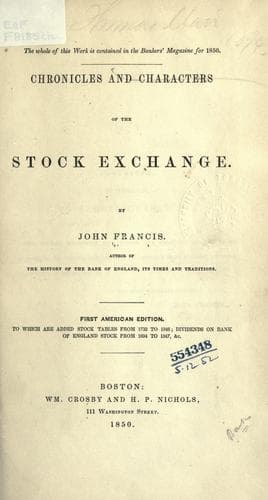
Chronicles and characters of the stock exchangeFrancis, John, of the Bank of England
History
Chronicles and characters of the stock exchange
Francis, John, of the Bank of England
Speculation; Stock Exchange (London, England)
The early mode of raising money was somewhat curious. When a new tax
was imposed by Parliament, any person might advance any sum not less
than £100. For this, a tally was given at the Exchequer, with an
order for repayment of the principal, and the payment of interest.
The sums thus advanced were to be paid off in regular order, as the
money arising from the tax was received. But as this was generally
found to be insufficient to redeem the loan, it became necessary
either to prolong the term, or raise a new loan to pay off the old
one.
The interest on loans during the reigns of Anne and William was very
uncertain. In the reign of George II. a new principle was adopted.
Instead of varying it according to the state of the money-market,
the rate was generally fixed at 3 or 3½ per cent., and the necessary
variation made in the sum funded. In consequence of this practice
having prevailed, the principal of the debt now existing amounts to
nearly two fifths more than the sum actually advanced.
As early as 1762, a stock-broker, named John Rice, met the fearful
penalty so liberally awarded to crime by the civil code of the
eighteenth century. A client of Rice, for whom he was accustomed to
receive her dividends, was, under false pretences, induced to grant a
power to sell as well as to receive the interest. As the temptation
to speculate on the Stock Exchange is great, the temptation to divert
property from its legitimate channel is equally so, when confidence
or carelessness has granted the power. The stock-broker sold all
his client’s money, employed it to meet his losses, and kept up his
deception by sending her the dividends as usual. The lady, moved by
doubt, or by some cogent but unknown cause, intimated to Rice her
intention of visiting the city. Unable to restore the money, the
conscience of Rice took the alarm, and he fled, leaving with his
wife £5,000 of the misappropriated property. Ignorant of his evil
deeds, and anxious to join her husband, she embarked for Holland. The
weather proved rough; the vessel was driven back; and the persons
sent in search of the husband apprehended the wife, who yielded the
money in her possession, leaving herself entirely destitute; and it
is to the credit of the directors of the South-Sea Company, that they
settled a small pension on the unhappy woman.
The search continued for Rice, who was discovered in the old town of
Cambray, where he had taken up his residence. The English ambassador
at Paris applied for his delivery; the misguided man found that
Cambray was no city of refuge for him; and the last sad penalty of
the law was enacted on the body of John Rice, the stock-broker.
Public-domain text, read in full here on John Shaqi.
Reviews
Reviews
No reviews yet
Be the first to share your thoughts on this work.
Elsewhere in the archive
Join the Discussion
Join the discussion
Sign in to leave a comment or review.
Sign InorCreate an account