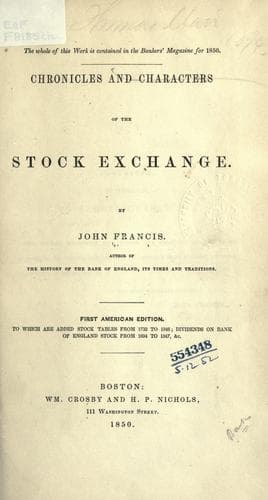
Chronicles and characters of the stock exchangeFrancis, John, of the Bank of England
History
Chronicles and characters of the stock exchange
Francis, John, of the Bank of England
Speculation; Stock Exchange (London, England)
It is the curse of English commerce, of English banking, and of
English trading generally, that, while large fortunes are made by the
principals, the clerks are often remunerated at a rate inferior to
that which the merchant pays his favorite domestic. The small number
necessary to produce a great income takes away all excuse for this
penury; and as four or five are frequently sufficient to produce
annual thousands, it is to be regretted that, while the principal
seeks the most luxurious abode which wealth can produce, the clerk
goes to some cheap suburban home, in which, with his family, he can
scarcely unite respectability with life.
In corporations and in public offices this is peculiarly hard. The
additional salary would not be felt, and there is a responsibility on
the clerks which demands that their payment should be proportioned to
it. It is an honor to them that, with the lax notions entertained of
corporate and national property, the frauds should be so rare; but
it is a dishonor to commercial nature, that, considering the profits
made by merchants, the daily intercourse they hold with their clerks,
and the trust they are compelled to place in them, they pay in so
small, and work in so great a degree. It is a most suggestive fact,
that, where the functionaries are remunerated the worst, the frauds
are most numerous.
But there is another evil felt by the stipendiary. His personal
treatment is not in accordance with his claims as an educated man.
The coldest look and the haughtiest answer are reserved for him. The
smallest amount of intercourse necessary to business is awarded him.
The common courtesies of life are denied him. The merchant too often
enters his counting-house without recognition, and leaves it without
an adieu.
In similar establishments abroad, the clerks are treated with care
and kindness. They are not made hourly to feel the great gulf between
them and their wealthy superiors. They visit the homes of the latter;
they are confidentially consulted; they are allowed time to think;
they are treated as men, not as animals. And thus it was in England
in the olden time. The merchant of that school invited his clerk to
his home, took an interest in his affairs, and recognized him as a
friend. They worked the fortunes of the house together, and, if the
merchant was repaid by his clerk’s fidelity, the latter was often
admitted into the firm he had served. This is not so now. But the
master is the greatest loser; for there is no service so fruitful as
that which arises from kindness, or so grateful as that which has its
root in affectionate respect.
Public-domain text, read in full here on John Shaqi.
Reviews
Reviews
No reviews yet
Be the first to share your thoughts on this work.
Elsewhere in the archive
Join the Discussion
Join the discussion
Sign in to leave a comment or review.
Sign InorCreate an account