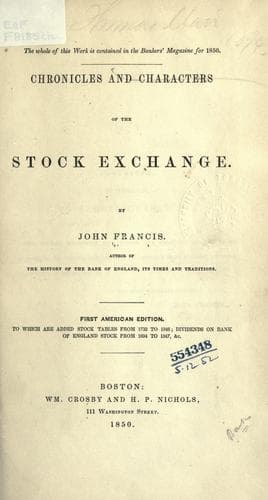
Chronicles and characters of the stock exchangeFrancis, John, of the Bank of England
History
Chronicles and characters of the stock exchange
Francis, John, of the Bank of England
Speculation; Stock Exchange (London, England)
In 1774, the number of Hebrew brokers was limited to twelve; and
the privilege was always purchased by a liberal gratuity to the
Lord Mayor. During this year, the mayoralty of Wilks, one of the
privileged being at the point of death, Wilks, with characteristic
boldness, openly calculated on the advantage to be attained, and was
very particular in his inquiries after the sick man. The rumor, that
Wilks had openly expressed a wish for the death of the Hebrew, was
spread by the wags of ’Change Alley, and the son of the broker sought
his Lordship to reproach him with his cupidity. “My dear fellow,”
replied Wilks, with the readiness peculiar to him, “you are greatly
in error. I would sooner have seen all the Jew brokers dead than your
father.”
“It is the nature of colonies, as of children, at a certain period
in their history, to cease to be dependent upon their parents. By
judicious counsel and control they may be retained, but they must
eventually separate; and, with the one as with the other, the future
influence of the parent depends upon that parent’s behaviour during
the nonage of the child.” Such was the opinion of William Pitt,
first Earl of Chatham; and it is to be lamented that the behaviour
of England to her American children was not likely to be remembered
with kindness, when the tie was violently broken. The story of that
disastrous war, when men of the same ancestry and the same habits
were arrayed in hostility, when they who spake the same tongue spake
it only in unkindness, is pitiable and humiliating. From the time
when the inhabitants of Boston refused to be taxed, to the signing of
the treaty with the young republic on terms of equality, the measures
adopted were as severe as they were injudicious; and to the obstinacy
of George III. may be traced the cause and the continuation of the
contest, and the increase of the national debt. The first blow was
struck at Boston. On the evening of December 16th, 1773, a number of
citizens, disguised as Mohawk Indians, boarded the vessels containing
the tea which they would not allow to be taxed, and discharged it
into the water, while other cargoes were not only refused a landing,
but were sent back with contempt.
Public-domain text, read in full here on John Shaqi.
Reviews
Reviews
No reviews yet
Be the first to share your thoughts on this work.
Elsewhere in the archive
Join the Discussion
Join the discussion
Sign in to leave a comment or review.
Sign InorCreate an account