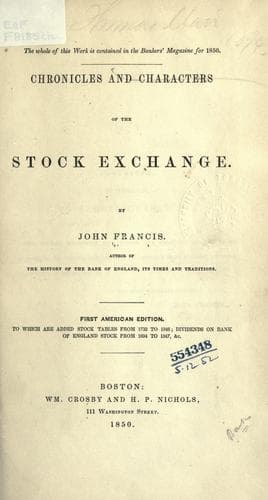
Chronicles and characters of the stock exchangeFrancis, John, of the Bank of England
History
Chronicles and characters of the stock exchange
Francis, John, of the Bank of England
Speculation; Stock Exchange (London, England)
When the news reached London, various restraining measures were
passed. The place which had witnessed the outrage was declared
closed for all exports and imports; and though the bold stand of
the provincials astonished the mother country, it was supposed to
be but temporary. It was soon found, however, that Boston was not
alone; other provinces joined; and British America called a general
congress. Magazines were formed; ammunition was provided; plans were
drawn up for the defence of the country; and a large body enrolled,
termed minute-men, engaged to turn out at a minute’s notice. Every
contingency was prepared for; and an aspect called rebellious by
the mother country was boldly presented. The first blood was shed
at Lexington, where British soldiers fled before American militia.
Emboldened by success, they reduced two forts, took Montreal,
and attempted Quebec. Nor was England idle in the struggle. An
addition to the land and sea force was voted; loans were raised;
reinforcements were ordered to Boston; and the military ardor which
had seized the Americans found fuel on which to expend itself.
With fire-arms formed by themselves; with weapons wrought from the
plough; with artillery so clumsily fashioned that it burst more often
than it discharged; with men who had only the determination to die
free rather than live bond,—the American generals beat the veteran
troops of England. Her forts were taken, her forces surrounded, her
armies destroyed, and her officers made prisoners. The principal
powers of Europe looked with delight upon a struggle between the
soldiers of the mother country and the raw recruits of the colony;
between discipline on the one side and patriotism on the other; on
the entire power of England baffled by men from the pen and from the
plough, from the shop and from the counting-house. The loans of this
disastrous period were most unpopular. The increased taxation which
followed was drawn with the utmost difficulty from the pockets of the
people.
Political misfortunes and military disasters made the subjugation
of America chimerical. Earl Cornwallis surrendered himself and his
army as prisoners of war; and when the contest was extended to
Europe,—when England stood alone against Holland, France, Spain,
and America,—when our navy was defeated,—when the English coast and
harbors were insulted, our West India Islands ravaged, and our trade
swept away,—the discontents of the country increased, and the debates
in the House grew violent and acrimonious. “You sheathe your sword,
not in its scabbard, but in the bowels of your countrymen,” said one;
and on some unhappy boast of driving the Americans into the sea,—“I
might as well,” said Lord Chatham, “think of driving them with my
crutch.” The people grumbled at defeat following defeat, at trade
crippled, at taxes augmented, and debts enlarged.
Public-domain text, read in full here on John Shaqi.
Reviews
Reviews
No reviews yet
Be the first to share your thoughts on this work.
Elsewhere in the archive
Join the Discussion
Join the discussion
Sign in to leave a comment or review.
Sign InorCreate an account