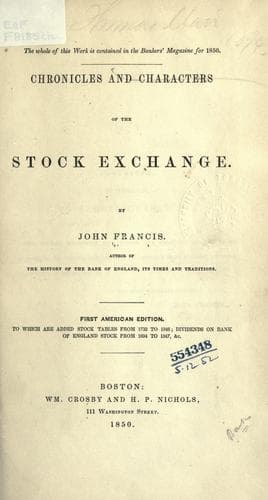
Chronicles and characters of the stock exchangeFrancis, John, of the Bank of England
History
Chronicles and characters of the stock exchange
Francis, John, of the Bank of England
Speculation; Stock Exchange (London, England)
Loan succeeded loan; a cry arose about the corruption of contracts;
and the feeling of discontent increased so strongly, that the
stubborn obstinacy of the king, who said he would sooner lose his
right arm than his colonies, was compelled to yield to a unanimous
resolution of the Commons, that the House would consider as enemies
all those who advised the continuance of the war. Had any other
monarch sat upon the throne, the large accumulation of debt would,
probably, have been avoided; and England would now be spared the
painful task of looking back upon “a nation convulsed by faction;
a throne assailed by the fiercest invective; a House of Commons
hated and despised; a rival legislature sitting beyond the Atlantic;
English blood shed by English bayonets; our armies capitulating; our
conquests wrested from us; our enemies hastening to take vengeance
upon us for past humiliations; and our flag scarcely able to maintain
itself in our own seas.”
Such was the aspect of public affairs during a war which cost
thirty-two millions in taxes, and added one hundred and four millions
to the national debt.
In 1778, when a loan was proposed, the usual number of applications
was delivered from the bankers, merchants, and members of the Stock
Exchange. To their surprise the answers were not received so soon
as usual; and, as political events were threatening, the applicants
grew anxious. The funds fell greatly; and, when the replies came,
it was found that the whole of this unfortunate loan was fixed upon
them. Had the funds risen, the members and the minister’s friends
would have had a good portion; but, as the scrip was sure to be at
a discount of three per cent., the whole was divided among those
who were either without interest or were opposed to the government.
In 1781, on a new loan being proposed, the same houses applied; but
as the scrip went to a premium, it was divided with due regard to
senatorial interests; and many who had lost on the last loan had no
opportunity of retrieving on the present.
Prior to the allotment, one firm was waited on by a stranger, and
told, that, if they would add his name to their list, they would be
favorably considered. The house declined the proposal, and sent in a
tender for two millions; when, to their surprise, they received, with
an allotment of £560,000, an intimation that the odd £60,000 was for
the gentleman who had waited on them, and of whom they knew nothing.
£240,000 was nominally given to another house; but of this £200,000
was for members whose votes were desirable. Mr. Dent, the head of
the house of Child, and a senator, received £500,000, being two
thirds of his tender; while Drummonds and other bankers, not members,
received only tenths and sixteenths of the sums they requested. Some
applicants, without Parliamentary interest, though as good as any in
the city, were totally neglected, while “to a number of mendicants,”
said Mr. Fox, “obscure persons, and nominal people, were given large
amounts.”
Public-domain text, read in full here on John Shaqi.
Reviews
Reviews
No reviews yet
Be the first to share your thoughts on this work.
Elsewhere in the archive
Join the Discussion
Join the discussion
Sign in to leave a comment or review.
Sign InorCreate an account