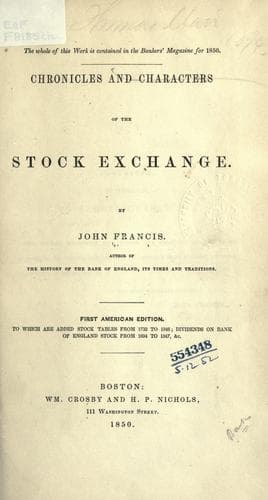
Chronicles and characters of the stock exchangeFrancis, John, of the Bank of England
History
Chronicles and characters of the stock exchange
Francis, John, of the Bank of England
Speculation; Stock Exchange (London, England)
The history of lotteries is one of those anomalies which it is the
duty rather than the pleasure of the annalist to record. A minute
picture, however, of the progress of these institutions, is as
necessary to the financial annals of the Stock Exchange as it is to
the development of the social history of a people. Invented by the
Romans to enliven their festivities, they were to that luxurious
people a new excitement; and the prizes distributed to their guests
were in proportion to the grandeur of the giver. Fine estates,
magnificent vases, and beautiful slaves, with other and less
expensive prizes, gratified at once the pride of the founder and the
cupidity of the guest.
The application, however, of lotteries to the service of a state
originated at Genoa, the government of which established the
principle for its own benefit. The Church was not long in following
the example at Rome, where the inhabitants deprived themselves of
necessaries to share the chances which their excited imaginations
magnified a hundredfold.
The first on record in England was drawn in 1569. The harbors and
havens of the whole line of coast were out of repair, and the only
mode of procuring money was by lottery. The prizes were partly in
money and partly in silver plate, and the profits to be applied to
the above purpose. But the drawing was a very important task; and, as
400,000 lots were to be drawn, night and day for nearly four months
were the people kept in a state of excitement. The time occupied must
have been somewhat tedious; and, as this was the first lottery, and
there were but three offices in London, it is to be supposed that
the drawing of that period bore the same proportion to the drawing
at a later time, that the coaches then bore to the railroads now. In
1612, another lottery was allowed for the benefit of the Virginia
colonies, in which a tailor gained the largest prize of 4,000 crowns.
But thus early was it found that lotteries and demoralization went
hand in hand. Sanctioned by the state as a source of gain, they were
found equally profitable to private individuals; and the town teemed
with schemes which brought wretchedness and ruin in their train. In
March, 1620, however, they were suspended by an Order in Council;
but it was only a suspension, and the evil was once more revived by
Charles I., who, to assist a project of conveying water to London,
granted a lottery towards its expenses. That which the first Charles
allowed for so great a purpose, the second of the name allowed as a
boon to those whom he could reward in no other way. It was in vain
for censors to preach, divines to sermonize, or the House of Commons
to legislate. While there was the chance of a great gain for a small
risk, men ran in crowds to subscribe. Those who could not pay a large
sum found plenty of opportunities to gamble for a small amount, and
penny lotteries became common.[4] In 1694 they were again employed by
the state, William III.
Public-domain text, read in full here on John Shaqi.
Reviews
Reviews
No reviews yet
Be the first to share your thoughts on this work.
Elsewhere in the archive
Join the Discussion
Join the discussion
Sign in to leave a comment or review.
Sign InorCreate an account