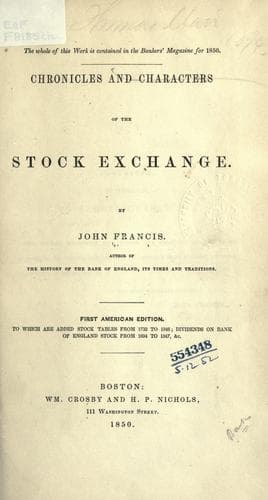
Chronicles and characters of the stock exchangeFrancis, John, of the Bank of England
History
Chronicles and characters of the stock exchange
Francis, John, of the Bank of England
Speculation; Stock Exchange (London, England)
There are many incidents, which, recorded in contemporary annals,
have been either overlooked or disregarded as insignificant. There
is, however, nothing insignificant connected with so important a
topic, and nothing ought to be overlooked on an evil which has eaten
to the very heart of society, and which may again be used by some
unscrupulous minister for some unscrupulous purpose. The declaration
of Sir Samuel Romilly, that “whenever the House voted a lottery, they
voted that the deserving should become depraved,” with the additional
assertion, that “the crimes committed would be chiefly bought off by
the paltry gain to the state coffers,” was entirely disregarded.
Let it be remembered that a chancellor declared “he could not
see that lotteries led to gambling,”—that though the Corporation
of London presented an earnest petition for their abolition, as
injurious to commerce and injurious to individuals,—that though Lord
Mansfield said the state exhibited the temptation and then punished
for the crime to which it tempted,—that though, on one occasion,
out of twenty-two convicts who left the country, eighteen commenced
their career with insuring,—that though forged notes were encouraged
from the carelessness with which lottery-office keepers received
and passed them,—that though it was iterated and reiterated that no
circumstances conduced so much to make bad wives and bad husbands,
bad children and bad servants,—that though men threw themselves into
the river from the infatuation of their wives,—though the plate of
respectable families was pledged to assist the mania,—that though the
poor-rates were increased, and the consumption of excisable articles
diminished, during the drawing,—that though the gambling and lottery
transactions of one individual only were productive of from ten to
fifteen suicides annually,—that though half a million sterling yearly
came from metropolitan servants,—that though four hundred fraudulent
lottery-offices were in London alone,—that though no revenue was
ever collected at so great an expense to the people,—that though
families pawned every thing they had, sold the duplicates, and were
reduced to poverty,—that though women forgot the sanctities of their
sex,—that though the parishes were crowded with applicants who had
reduced themselves by insurances,—that though perjury was common,
and small annuitants squandered their resources,—that although all
these pictures were drawn, and statements made, so publicly and so
prominently that they could not fail to reach even the obtuse ears
of a dominant ministry,—yet it was not until 1826 that the evil
was abolished. A similar pressure may recall the evil. It is of no
importance to argue that lotteries are forbidden, and that the morals
and the minds of the people are more regarded. Lotteries have been
repeatedly forbidden, but they have been invariably renewed when the
coffers of the state were low; and the morals of the people are a
Public-domain text, read in full here on John Shaqi.
Reviews
Reviews
No reviews yet
Be the first to share your thoughts on this work.
Elsewhere in the archive
Join the Discussion
Join the discussion
Sign in to leave a comment or review.
Sign InorCreate an account