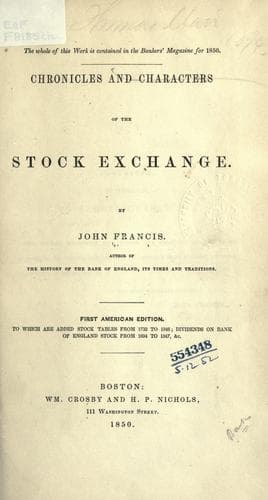
Chronicles and characters of the stock exchangeFrancis, John, of the Bank of England
History
Chronicles and characters of the stock exchange
Francis, John, of the Bank of England
Speculation; Stock Exchange (London, England)
It was in vain that the smaller lotteries were put down; they only
gave way to an evil which preyed upon the very vitals of English
society. Insurance, an art upon which hundreds grew rich, while
hundreds of thousands grew poor, was commenced with terrible success.
Those who were unable to buy tickets, paid a certain sum to receive
a certain amount if a particular number came up a prize. A plan like
this was available for all, as the amount could be varied to the
means of the insurer.
It is almost impossible to describe the many iniquities, the
household desolation, the public fraud, and the private mischief,
which resulted from insuring. Wives committed domestic treachery;
sons and daughters ran through their portions; merchants risked the
gains of honorable trade. “My whole house,” wrote one, “was infected
with the lottery mania, from the head of it down to my kitchen-maid
and post-boy, who have both pawned some of their rags that they might
put themselves in fortune’s way.” The passions and prejudices of the
sex were appealed to. Lovers were to strew their paths with roses;
husbands were plentifully promised, and beautiful children were to
adorn their homes through the lottery. And all these glories were
promised when Adam Smith declared, as an incontrovertible fact, that
the world never had, and never would, see a fair lottery. So great
were the charms of insuring, while the chances were so small, that
respectable tradesmen, in defiance of the law, met for this illegal
purpose, on the following day to that on which some of their body had
been taken handcuffed before a magistrate. The agents were spread in
every country village, and the possession of a prize was an absolute
curse to the community. Its effects were witnessed alike in the shock
it gave to industry, and the love of gambling it spread among the
people. It is due to those whose voices were lifted up against these
abominations to say, that their appeals to the good feeling of the
government were incessant; but the state replied in that language
which is so unanswerable when held by a firm government, that the
necessities of the state overbalanced the evils of the lottery.
Nor could ignorance be pleaded of its fatal effects. The domestics of
the senators themselves purchased shares with their masters’ money;
and members of the lower and upper house were unable to resist the
fascinations of the game they condemned. The most subtle language was
not wanting to support the cause. Scripture was used to defend it;
and as the Bible was perverted by the supporters of the slave-trade,
and lately by the discoverers of the virtues of chloroform, so was
it now wrested to prove the antiquity and sanctity of lotteries. “By
lot,” they said, “it was determined which of the goats should be
offered to Aaron. By lot the land of Canaan was divided. By lot Saul
was marked out for the kingdom. By lot Jonah was discovered to be the
cause of the storm.”
Public-domain text, read in full here on John Shaqi.
Reviews
Reviews
No reviews yet
Be the first to share your thoughts on this work.
Elsewhere in the archive
Join the Discussion
Join the discussion
Sign in to leave a comment or review.
Sign InorCreate an account