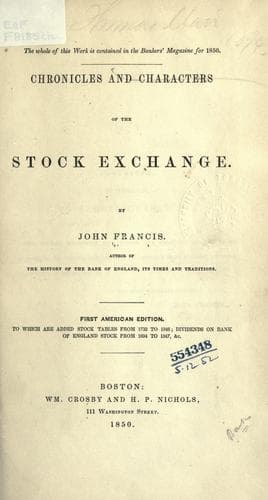
Chronicles and characters of the stock exchangeFrancis, John, of the Bank of England
History
Chronicles and characters of the stock exchange
Francis, John, of the Bank of England
Speculation; Stock Exchange (London, England)
“In the lower classes of society, the persons engaged are, generally
speaking, either immediately or ultimately tempted to their ruin;
and there is scarcely any condition of life so destitute and so
abandoned, that its distresses have not been aggravated by this
allurement to gambling.”
Notwithstanding the strong nature of this report, the labors of the
committee were fruitless. Various attempts at amelioration were made,
but the evil was not finally abolished until the year 1826.
FOOTNOTES:
[4] Mr. J. B. Heath says of the early lotteries, in his valuable
volume entitled “Some Account of the Grocers’ Company,”—“There is not
one entry in the accounts to show that the prizes were ever paid,”
and quotes various documents to prove that they were very difficult
to procure. “The science of puffing,” adds this gentleman, “which in
our times has attained such perfection, was unknown at that period,
and in lieu of placards and advertisements, the more direct mode was
adopted of personal solicitation.”
CHAPTER IX.
_Wholesale Jobbing.—Insurance on Sick Men.—False
Intelligence.—Uselessness of Sir John Barnard’s Act.—Origin
of the Blackboard.—Opposition to Loans.—Lord Chatham’s
Opinion of Jobbers.—Inviolability of English Funds.—Parisian
Banking-Houses.—Proposition to pay off the National
Debt.—Extravagance of the Contractors.—Lord George Gordon’s
Opinion of them.—Members’ Contracts.—New System adopted.—Abraham
Goldsmid.—Bankers’ Coalition broken by him.—His Munificence.—His
Death.—Sensation in the City._
The following picture of wholesale jobbing, drawn from public and
private documents, from correspondence, from newspapers, and from
Parliamentary history, will show that gambling was equally pursued in
high places as in ’Change Alley.
Letters from abroad, containing false intelligence, were forwarded
to, or forged by, senators; names of importance were fraudulently
used; the news was promulgated, and funds raised or lowered according
to the wish of the contriver. But if the jobber was cheated in one
way, he took his revenge in another. The domestics of public men
were bribed by him; the secretaries of men in office were paid by
him; the mistresses of ministers were accessible to him; and, it is
said, even their wives were not seldom in the pay of members of the
Stock Exchange. Nor did many hesitate to declare that men in office
not only made profit of the news they really received, but that they
promulgated false intelligence, knowing, from their position, it
would be received as true, at the expense of their own character, and
to the ruin of the men who trusted them.
Public-domain text, read in full here on John Shaqi.
Reviews
Reviews
No reviews yet
Be the first to share your thoughts on this work.
Elsewhere in the archive
Join the Discussion
Join the discussion
Sign in to leave a comment or review.
Sign InorCreate an account