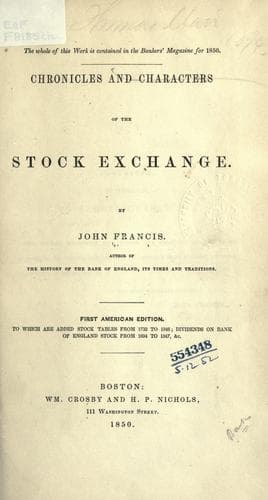
Chronicles and characters of the stock exchangeFrancis, John, of the Bank of England
History
Chronicles and characters of the stock exchange
Francis, John, of the Bank of England
Speculation; Stock Exchange (London, England)
Another practice had obtained a notoriety so bad and baleful, that
it became necessary to stop its progress. Directly it was known that
any great man was seriously ill, insurances on his life, at rates
in proportion to his chance of recovery, were made. These bargains
were reported in the papers; and the effect on an invalid who knew
his health to be precarious may be imagined, when he saw in the
_Whitehall Evening Post_, that “Lord —— might be considered in great
danger, as his life could only be insured in the Alley at ninety per
cent.” The custom grew so rapidly, and the evil was so serious, that
the principal merchants and underwriters refused to transact business
with brokers who engaged in such practices.
Of a less questionable character was the habit of insuring property
in any besieged city; or the yet more common mode of paying a premium
to receive a certain sum, should the city be taken by the day named
in the contract. The Spanish ambassador was accused of insuring
£30,000 on Minorca, during the seven years’ war, when the despatches
announcing its capture were in his pocket.
The newspapers were the vehicles generally employed to spread false
intelligence; and an almost invariable success attended those who
made use of the press to promulgate, in bold type and inflated
language, “bloody engagement,” “rumored invasion,” or “great
victory,” to assist their city operations. Every class, from the
maiden who jobbed her lottery-ticket, to the minister who jobbed
his intelligence, was involved in the pursuit. All these bargains
were for time, and continued to prove that the act by which Sir John
Barnard hoped to abolish gambling was useless; and it is an anomaly
in the history of our great debt, that bargains in the very funds
which were raised to support the national credit are disallowed by
the national legislature. It is a law which has been tried and found
wanting. It does not prevent, in the smallest or slightest degree,
the system it was meant to crush; and it adds to the immorality of
the speculator and the risk of the broker, by allowing the former to
repudiate his bargain at the expense of the latter.
Under the early loan-acts, tallies were delivered to the first
contractors. When a sale was effected, the name of the purchaser was
indorsed upon the tally, and from that entered into the government
books, for the convenience of paying the dividends to the right
person. This clumsy machinery was afterwards abolished; but though,
in 1717, the transfers and dividends of the national debt were first
undertaken by the Bank, it was not until 1783 that the present method
of transfer was adopted.
Public-domain text, read in full here on John Shaqi.
Reviews
Reviews
No reviews yet
Be the first to share your thoughts on this work.
Elsewhere in the archive
Join the Discussion
Join the discussion
Sign in to leave a comment or review.
Sign InorCreate an account