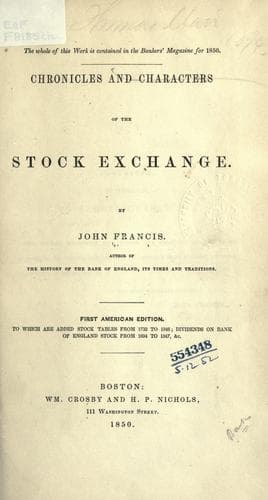
Chronicles and characters of the stock exchangeFrancis, John, of the Bank of England
History
Chronicles and characters of the stock exchange
Francis, John, of the Bank of England
Speculation; Stock Exchange (London, England)
checked the document, and discovered the forgery.
The scheme to which this gentleman had so nearly fallen a prey was
cunningly contrived. The effeminate applicant to Mr. Martin was
the sister of Lyons, disguised in male attire,—Lyons having placed
himself in the way at the proper moment to give the necessary
character; and, had it not been for the chance circumstance
alluded to, would have profited largely by the deceit. The scheme
failed; Lyons was apprehended; and, rather than give his sister
the affliction of appearing against him, he pleaded guilty; thus
sacrificing the slight chance of life which remained, to spare the
feelings of her whom he had betrayed into crime.
In 1796 a loan for eighteen millions was proposed. The usual
inquiries were made by the interested parties, and the Chancellor
of the Exchequer positively declared that it should be conducted
upon principles of free and open competition. The day was appointed
to arrange its preliminaries. Mr. Mellish, Mr. James Morgan, and
Mr. Boyd, were competitors; and when they had assembled, Mr. Boyd
requested a few words in private with the Chancellor. The request
was granted; and the surprise of Messrs. Mellish and Morgan may be
conceived, when the Chancellor, on returning, proposed, that, if the
latter bid for the loan, Mr. Boyd should be at liberty to supersede
them on paying half per cent. above the highest offer. This was
decidedly and indignantly refused; and the Chancellor, without any
other proposition, at once agreed to take the terms offered by Mr.
Boyd, although it was fully understood by all that there should be no
final settlement on that day. The real causes of this extraordinary
proceeding are difficult to ascertain; but the excuse offered by
the Chancellor was, that Boyd had some claim on government, in
consideration of the previous loan not having entirely expired.
Allowing this, the state had no right to remunerate Mr. Boyd at the
expense of others; and as very little of the previous scrip remained
in his possession, it was, whatever partisanship might allege in
excuse, a gross dereliction of public duty, and a great misdirection
of public interest, to allot a loan without competition, at a loss
of £499,500 to the public. At any rate, the contract was notified as
open, the Governor of the Bank was authorized to declare it so, and
the Chancellor expressed no doubt upon the subject.
There was much comment at the time. There was also a curious story in
circulation of bills to the amount of £700,000 having been drawn on
the treasury in fictitious names, and with fictitious dates; and it
was asserted that, when the loan was contracted, it was absolutely
known by the Cabinet that the king’s speech would inevitably raise
the funds, and add five per cent. to the gains of the contractor.
Before the first payment, £2,160,000 was the profit on a contract for
eighteen millions.
Public-domain text, read in full here on John Shaqi.
Reviews
Reviews
No reviews yet
Be the first to share your thoughts on this work.
Elsewhere in the archive
Join the Discussion
Join the discussion
Sign in to leave a comment or review.
Sign InorCreate an account